Most merchants who ask us “can you surcharge debit cards?” are not asking out of curiosity. They’re asking because they’ve been doing it for six months and something finally made them nervous. A customer complained. A processor sent an email with the word “assessment” in it. A competitor down the street got a letter from the state attorney general.
Here’s the short version, and then we’ll get into the part that actually matters — the mechanics of how businesses end up in violation without ever deciding to break a rule.
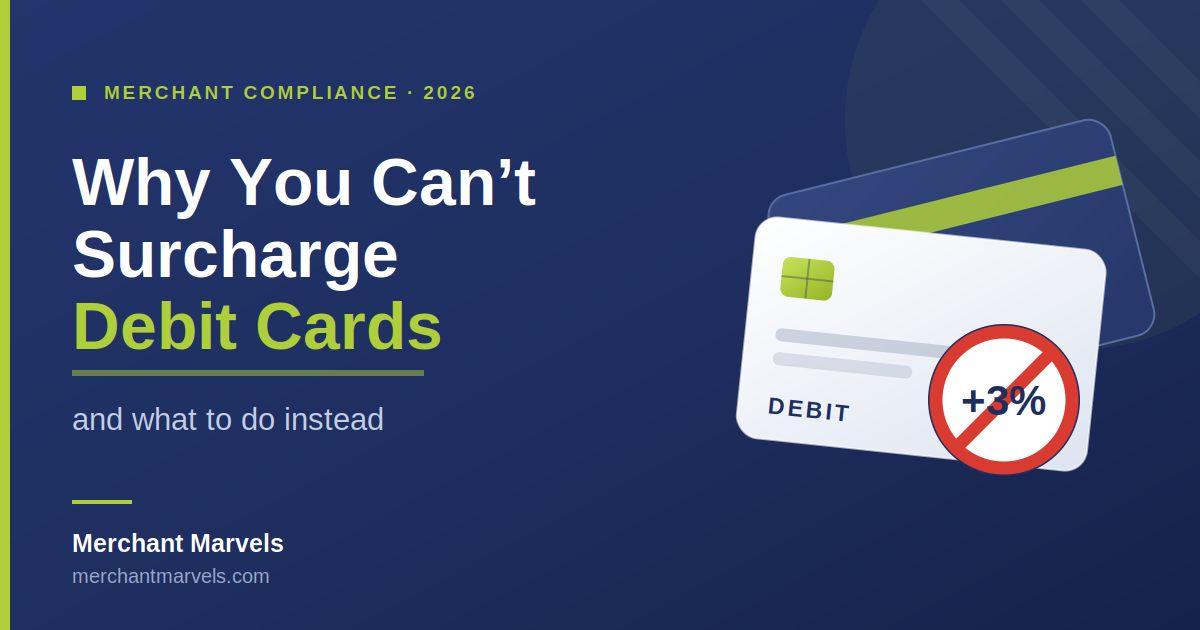
No. You cannot surcharge debit cards. Not in any state, not on any network, not at any percentage. The prohibition applies to PIN debit, signature debit, prepaid cards, gift cards, and payroll cards. It applies even when the customer taps the “credit” button at the terminal. There is no version of a compliant surcharge program that includes debit.
What you can do is run a program that removes processing costs from your P&L without ever touching a debit transaction with a fee. That’s the second half of this article.
Why debit sits under a completely different set of rules
Credit card surcharging in the United States became broadly permissible after a 2013 legal settlement between the card networks and merchants, and after the Supreme Court’s 2017 decision in Expressions Hair Design v. Schneiderman opened the door for state-level challenges to surcharge bans. Merchants have spent the decade since then getting comfortable with the idea that passing on card costs is normal.
Debit never came along for that ride. It sits under three separate layers of rules, and you have to clear all three.
Layer one: card brand operating rules. Visa and Mastercard both permit surcharging on credit transactions and both explicitly exclude debit and prepaid. This is not a state-by-state matter and it is not negotiable with your processor. It’s a term of the merchant agreement you signed. Visa caps credit surcharges at 3% of the transaction, down from 4% since April 15, 2023. Mastercard’s cap is 4%. If you accept both brands, 3% is your practical ceiling. And in every case the surcharge can’t exceed your actual cost of acceptance, whichever number is lower.
Layer two: PIN debit network rules. There’s a persistent myth that PIN debit routes through different networks and therefore falls outside the ban. It doesn’t. STAR, NYCE, Pulse, Accel and the rest carry their own prohibitions on surcharging in their operating rules. The Durbin Amendment requires every debit card to be routable over at least two unaffiliated networks — and both of them will prohibit surcharging. There’s no routing path that gets you to a legal debit surcharge.
Layer three: state statutes. This is the layer almost nobody checks, and it’s where the most interesting compliance nuance lives.
The nuance almost every article gets wrong
You’ll read constantly that “federal law bans debit card surcharges.” That’s a shortcut, and understanding why it’s wrong tells you where your real risk sits.
The Durbin Amendment and the Federal Reserve’s Regulation II govern the interchange relationship — what issuing banks can charge for debit transactions, and how those transactions must be routed. They regulate fees between financial institutions and merchants. They do not directly govern what a merchant charges a customer at checkout. In fact, Durbin does the opposite of banning things on the merchant side: it explicitly protects a merchant’s right to offer discounts by payment method. That protection is the legal foundation of everything in the “what to do instead” section below.
So the debit surcharge ban is primarily a network rules issue and a state law issue, not a Federal Reserve enforcement issue. Practically, that means three things:
- Your merchant agreement is the document you’ll be judged against. The party that comes after you is Visa, Mastercard, or your acquiring bank — not a federal regulator. That’s a faster and less forgiving process than a government enforcement action, with no notice-and-comment period and no appeal to speak of.
- The rules can change without any legislature voting on anything. Card brand rules get revised on the networks’ schedule.
- State debit statutes survived the court challenges that gutted the credit statutes.
That third point is worth dwelling on. Texas is the cleanest example. Chapter 604A of the Texas Business and Commerce Code contains two separate provisions: § 604A.0021 prohibits credit card surcharges, and § 604A.002 prohibits surcharges on debit and stored-value cards. In Rowell v. Paxton (2018), a federal court held the credit provision unconstitutional as applied, on First Amendment grounds, and the state was enjoined from enforcing it. The debit provision was untouched. It’s still on the books, still enforceable, and carries a civil penalty of up to $500 for each knowing violation.
That pattern repeats. The wave of litigation that opened up credit card surcharging in the mid-2010s was built on a free-speech argument about how merchants are allowed to describe their prices. It did nothing for debit, because the networks’ debit prohibition is a private contract term, not a state speech restriction. A merchant in a state where credit surcharging is now perfectly legal can still be in violation on debit under both network rules and a separate state statute.
The 2026 settlement expanded surcharging rights — and left debit exactly where it was
If you follow payments news, you know the biggest change to card rules in twenty years is currently working through the courts.
On November 10, 2025, Visa and Mastercard announced an amended interchange settlement resolving litigation that began in 2005. U.S. District Judge Brian Cogan granted preliminary approval on June 9, 2026, calling the terms fair and reasonable, though final approval and the appeals that several large retail groups have promised are still ahead. The terms are genuinely significant for merchants: an end to the honor-all-cards rule in its old form, the ability to decline certain premium and commercial card categories, temporary interchange reductions, and expanded surcharging rights at either the brand level or the product level, capped at 3%.
Read that list again and notice what’s missing. Every single one of those expansions applies to credit. The debit prohibition did not move an inch. The largest merchant-side win in the history of card litigation did not touch it.
The practical takeaway is the opposite of relaxation. More merchants are going to turn on surcharging over the next two years because the rules just got friendlier. More surcharging means more consumer complaints, more mystery shopping, and more enforcement attention on exactly the failure mode described in the next section.
Where merchants actually get caught
Nobody sits down and decides to surcharge debit. It happens through configuration, and here are the ways we see it happen:
The terminal applies a flat percentage to everything. The most common cause by far. Someone set up a 3% add-on at the item or ticket level rather than configuring a true surcharge program that performs a card-type lookup at authorization. Every debit tap gets 3% added. The merchant has no idea because the receipt looks fine.
The “credit” button is treated as the source of truth. A debit card run as signature debit is still a debit card. Card type is determined by the BIN and product code returned during authorization, not by which button the customer pressed. If your program logic keys off the transaction path instead of the card product, you’re surcharging debit several times a day.
Prepaid and gift cards. A Visa-branded prepaid card, a payroll card, an FSA or HSA card — these are excluded from surcharging alongside debit. Programs configured around a simple “is it credit or debit” binary tend to misclassify them.
Online and keyed transactions. In card-present retail the terminal resolves card type instantly. In e-commerce and invoicing, some setups display and total the fee before authorization returns the card product. If your checkout page adds 3% at cart and then processes a debit card, the surcharge was already applied.
Receipt language. A fee labeled “non-cash adjustment,” “card fee,” “service fee,” or “convenience fee” that behaves like a surcharge is a surcharge. Naming it something else is not a compliance strategy — it’s usually the thing that turns a rules violation into a deceptive-practices allegation.
Multi-state e-commerce. If you sell nationwide from Delaware, a surcharge that’s fine in most states is a problem in Connecticut, Massachusetts, Maine, and Puerto Rico, and needs different handling under New York’s price-display law and Colorado’s 2% cap. The debit ban is the one rule that’s uniform in all fifty states — everything else varies and changes.
Nobody filed the 30-day notice. Before you begin surcharging, you owe your acquirer and the networks written notice at least 30 days in advance, including your business details, whether you’re surcharging at the brand or product level, and the amount. Skipping this puts you in violation before the first transaction clears.
What it costs when it goes wrong
The enforcement mechanism is indirect, which is why it surprises people. The network fines your acquiring bank; your acquiring bank passes it to you.
Since April 15, 2023, an acquirer whose merchant is identified as surcharging improperly can be assessed an immediate $1,000 fine, with escalating amounts for continued violations. Visa fields consumer complaints through a public form and runs periodic mystery shopping through outside auditors, so “nobody will notice” is a weak bet. Repeat violations lead to larger assessments and, at the end of the ladder, termination of your merchant account.
Termination is the outcome that actually hurts. A merchant terminated for rules violations can end up listed on MATCH, the industry’s shared terminated-merchant database, which makes obtaining a new merchant account very difficult for up to five years. Losing card acceptance entirely is an extinction-level event for most retail and restaurant businesses.
On top of that sits state exposure: civil penalties (Texas up to $500 per knowing violation on debit; New York up to $500 per violation on its disclosure rules; Connecticut’s long-standing ban carries its own damages), attorney general enforcement, and in some states private rights of action that make class treatment possible. And separately from any of it, you may owe refunds of every improper surcharge you collected.
What to do instead, option one: surcharge credit, absorb debit
This is the standard structure and it’s what we set up for most established businesses.
The program applies a surcharge only to credit transactions, capped at 3%. Debit and prepaid transactions are identified at authorization and pass through at the posted price with no fee added. The debit processing cost stays on the merchant side of the ledger.
On a $100 ticket:
- Customer pays with a credit card: $103.00 total, you net $100.00.
- Customer pays with a debit card: $100.00 total, you pay roughly 1.5%, you net $98.50.
Whether that’s a good trade depends entirely on your debit mix. In restaurants, salons, and professional services where average tickets run higher, credit dominates and the economics are excellent. In convenience, quick-service, and anywhere the average ticket is under $20, debit can be half or more of your card volume, and you’re still carrying real cost.
The advantage of this structure is that it requires no change to how you price or display anything. Your menu, your shelf tags, and your website stay exactly as they are.
What to do instead, option two: cash discount and dual pricing
This is the answer for merchants who want debit cost covered too — and it works precisely because it never adds a fee to anything.
How it sidesteps the debit rule: a cash discount program isn’t a surcharge. Your posted price is the card price. Customers who pay cash receive a discount off that posted price at checkout. Since no fee is ever added to a card transaction, there is nothing to improperly add to a debit transaction. Debit customers simply pay the listed price like everyone else.
The legal foundation is solid on both sides. Card network rules expressly permit discounts to steer customers toward alternative payment methods, and the Durbin Amendment protects a merchant’s right to offer them. Cash discounting is legal in all fifty states, including Connecticut, Massachusetts, Maine, and Puerto Rico where credit surcharging isn’t an option at all.
Dual pricing is the close cousin: instead of one posted price with a discount applied at checkout, you display both prices side by side on every item — cash price and card price. It’s the most transparent version and the easiest to defend if anyone questions it, and it’s the structure New York’s price-display law effectively pushes merchants toward.
Cash discount is not a loophole, and it has its own rules. The programs that get merchants in trouble are the ones that are surcharges wearing a costume:
- The posted price has to be the genuine price every card customer pays. You can’t post the cash price and then “adjust” upward at the register.
- The discount must be a real reduction off the posted price, applied at the point of sale.
- The receipt must not show an added fee. A line item reading “non-cash adjustment 3%” describes a surcharge and will be treated as one.
- Signage is still required, at the entrance and at the point of sale.
- Pricing has to be applied consistently across the whole catalog.
The single most common compliance failure in this space is running a surcharge and calling it a cash discount. Configuration and receipt language are what determine which one you’re actually operating, not what your marketing calls it.
Which structure fits your business
| Situation | Better fit |
|---|---|
| Established business with printed menus, shelf tags, or a published price list | Surcharge — credit only, no repricing needed |
| New business setting prices for the first time | Cash discount / dual pricing — build it into the price from day one |
| High debit mix, low average ticket (convenience, QSR, laundromat, vape) | Cash discount — covers debit cost too |
| Operating in CT, MA, ME, or Puerto Rico | Cash discount — surcharging isn’t available |
| Selling online across many states | Cash discount / dual pricing — one consistent rule everywhere |
| Colorado | Either, but the surcharge cap is 2%, not 3% |
A ten-minute self-audit
If you’re already running a program, do this today:
- Take your own personal debit card and run a small live transaction. Then run one on a credit card. Compare the two receipts.
- Run the debit card a second time, choosing “credit” at the prompt. If a fee appears, you have a violation happening every day.
- Read the fee line on the receipt. Does it say “surcharge”? Does it say “non-cash adjustment”? The wording has to match what the program actually is.
- Test a prepaid or gift card if you have one.
- Check your online checkout — does the fee get added before or after card type is known?
- Confirm your 30-day notice to the acquirer is on file, with the correct percentage and level.
- Compare your surcharge percentage against your actual effective rate. Surcharging above your cost of acceptance is its own violation.
- Check signage at the entrance and at the register, and check that it matches your program type.
Frequently asked questions
Can you surcharge debit cards? No. Card network rules prohibit it nationwide, several states prohibit it by statute, and the PIN debit networks prohibit it in their own rules. There is no state and no card type combination where it’s permitted.
What if the customer runs their debit card as credit? Still prohibited. Card type is determined by the card product identified at authorization, not by the transaction path or the button pressed.
What about a flat fee instead of a percentage? A fee of any shape on a debit transaction is a surcharge. On the credit side, ask your processor which forms your program supports, since it varies.
Are prepaid cards treated as debit? Yes, for surcharging purposes. Prepaid, gift, payroll, and similar stored-value products are excluded alongside debit.
Is cash discounting legal in all fifty states? Yes, when structured properly — genuine posted price, genuine discount at the point of sale, proper signage, and no added fee on the receipt.
Do I have to tell anyone before I start surcharging? Yes. At least 30 days’ written notice to your acquirer and the card networks before your first surcharged transaction.
Did the 2026 Visa/Mastercard settlement change the debit rule? No. It expanded credit card surcharging rights and changed the honor-all-cards rule. Debit was not part of it.
The bottom line
The question “can you surcharge debit cards” has a one-word answer, but the reason it keeps getting asked is that the violation almost never looks like a violation from the merchant’s side. The terminal was configured once, by someone else, and it’s been quietly adding a percentage to every debit tap since. Nobody complained. The receipts looked normal. And then one day the acquirer’s compliance team sends an email.
The fix isn’t complicated. Either your program identifies card type at authorization and surcharges credit only, or you run a properly built cash discount program that never adds a fee to anything and therefore covers debit cost as cleanly as it covers credit. Both are legitimate. Both are widely used. The only bad option is a percentage applied to everything and hope.
We set your program up so you stay fully compliant — ask us how. We’ll look at your current terminal configuration, your receipt language, your signage, and your actual debit-to-credit mix, tell you which structure fits your business, and file the notices for you. Our surcharge programs run at 3% on credit with debit handled on the merchant side, and our cash discount programs are built to be defensible in all fifty states. It takes about fifteen minutes on the phone.
This article is general information about payment industry rules and is not legal advice. Card network rules and state statutes change; verify the current position for your state and your processor before launching or changing a program. Last reviewed: August 2026.