If you’ve been looking for a way to stop losing 3% of every sale to processing fees, you’ve probably run into two options: a cash discount program and a surcharge program. They get talked about as if they’re the same thing. They aren’t.
Both get you to roughly the same place — you keep close to 100% of your sale — but they take different routes to get there, they treat your customers differently, and they carry different rules. Choosing the wrong one for your business type can cost you customers or put you out of compliance.
Here’s the honest head-to-head on cash discount vs surcharge.
The Short Version
| Cash Discount (Dual Pricing) | Surcharge | |
|---|---|---|
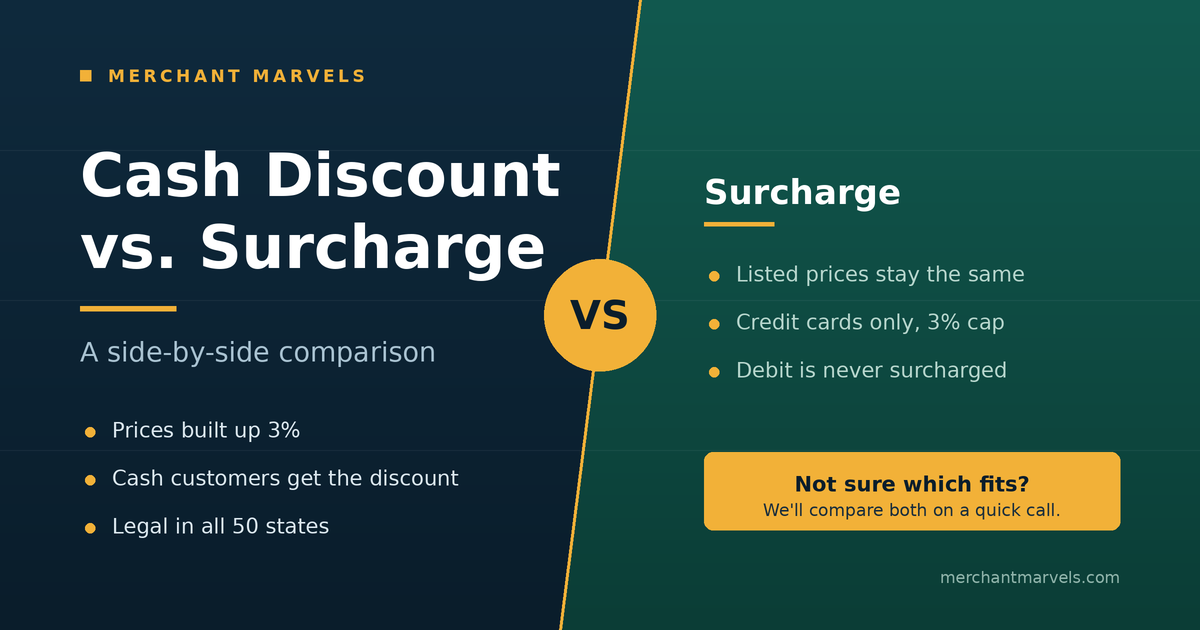
| How it works | Listed prices are raised ~3%. Customers who pay cash get that 3% back as a discount. | Listed prices stay the same. A ~3% fee is added at checkout for credit cards only. |
| Who pays the fee | Everyone paying by card (credit and debit) pays the listed price. | Credit card users only. |
| Debit cards | Pay the listed (higher) price like any other card. | Never surcharged. The merchant absorbs the debit cost. |
| What the receipt shows | A discount line for cash customers. | A surcharge line for credit customers. |
| Where it’s allowed | All 50 states. | Legal in the large majority of states, with a few exceptions and caps. |
| Best fit | New businesses, or anyone setting prices from scratch. | Established businesses with published prices they don’t want to change. |
| Card network cap | N/A — it’s a discount, not a fee. | 3% maximum under Visa and Mastercard rules. |
Mechanics: What Actually Happens at the Register
Cash Discount / Dual Pricing
You build the cost of card acceptance into your listed price. A $10 sandwich becomes $10.30 on the menu. If the customer pays cash, they pay $10 — the 3% comes off as a discount. If they pay by card, any card, they pay the listed $10.30.
The key thing to understand: there is no fee anywhere in this model. You are not adding anything. You’re offering a reward for cash. That’s the legal distinction, and it’s why this program works everywhere.
Surcharge
Your prices stay exactly where they are. The POS reads the card at the moment of the transaction, identifies whether it’s credit or debit, and adds the surcharge only to credit transactions. Debit cards go through at face value — no fee to the customer — and the merchant covers that cost (usually a much lower rate, around 1.5%).
The surcharge shows up as its own line on the receipt, clearly labeled.
Who Actually Pays
This is the real difference, and it’s worth sitting with.
Under a cash discount program, the cost is spread across every non-cash customer. Your debit customers pay it too. Since a large share of everyday transactions are debit, that means more of your volume is covered — and your effective cost of acceptance drops closer to zero.
Under a surcharge program, only credit card users pay. Debit customers are untouched. That’s friendlier to a big chunk of your customer base, but it means you’re still absorbing the debit processing cost yourself.
Neither is “better.” One shifts more cost off your books; the other is gentler on more of your customers.
Customer Experience
Customers respond to framing more than to math, and that’s the whole ballgame here.
Cash discount reads as a reward. Nobody objects to a discount. The sticker price is the price, and paying cash is a bonus. There’s no moment at the terminal where a customer sees a fee appear and asks what it is. In practice, this generates far fewer questions at the counter.
Surcharge reads as a fee — because it is one. Some customers won’t blink. Others will ask. The trade-off is that your listed prices stay familiar, which matters enormously if you have regulars who know what your prices are supposed to be.
Either way, signage is not optional. Clear notice at the entrance, at the register, and on the receipt is required under card network rules and, in several states, under law. Done right, it eliminates almost all friction. Done sloppily, it creates a complaint.
Which Suits Which Business
Choose a cash discount / dual pricing program if:
- You’re a new business and haven’t published prices yet. Building the 3% in from day one means no customer ever experiences a price increase. This is the single cleanest scenario for this model.
- You want debit volume covered too.
- You operate in a state with surcharge restrictions.
- You’d rather not have a fee line item on any receipt.
- You have a meaningful cash customer base already — restaurants, salons, convenience stores, food trucks.
Choose a surcharge program if:
- You’re an established business with prices your customers already know, printed menus, or an online catalog you don’t want to reprice.
- Your customer base skews heavily toward debit, and you’d rather protect them.
- You’re in a B2B or higher-ticket environment where an itemized fee is normal and expected.
- You want the cleanest possible separation between your price and your cost of acceptance.
A Note on the Rules
The legal landscape here changes, so treat this as orientation rather than legal advice.
Cash discounting is permitted nationwide — it’s been federally protected since the 1980s and no state prohibits offering a discount for cash.
Surcharging is legal in the large majority of states, but not all. As of 2026, Connecticut, Massachusetts, and Puerto Rico prohibit credit card surcharges. Colorado caps surcharges at 2%. California and Texas have surcharge statutes that federal courts have found constitutionally problematic, which makes enforcement there genuinely murky. A handful of other states — New York, New Jersey, Nevada, South Dakota, and others — allow surcharging but require it to stay at or below your actual cost of acceptance, and impose specific disclosure rules.
Three rules apply everywhere surcharging is allowed:
- The cap is 3%. Visa lowered its ceiling from 4% to 3% in 2023 and Mastercard followed.
- Debit cards can never be surcharged. Not by any program, in any state. Your POS has to reliably tell credit from debit.
- You must notify the card networks and your processor — generally 30 days before you start.
This is exactly the part most merchants shouldn’t have to figure out alone. A properly configured system handles card-type detection, capping, and receipt disclosure automatically, so compliance isn’t something you think about after setup.
How to Choose: Three Questions
- Are your prices already out in the world? If yes, lean surcharge. If you’re starting fresh, lean cash discount.
- What’s your debit-to-credit mix? Heavy debit and you’d rather protect those customers? Surcharge. Want maximum coverage? Cash discount.
- Where do you operate? If you’re in a restricted state, dual pricing is the answer, and the question is settled.
If you’re still torn, that’s normal. For most businesses the difference in take-home is small; the difference in how it feels to your customers is not. That’s the variable worth optimizing for.
Not Sure Which Fits Your Business?
We’ll compare both for you on a quick call — your state, your ticket size, your debit-to-credit mix, and what your customers are actually used to seeing. No pressure, no obligation, and you’ll walk away knowing which program makes sense even if you don’t work with us.
Book a call with Merchant Marvels →
Merchant Marvels provides POS systems and merchant services to businesses nationwide, including free equipment placement with no upfront cost, no contract, and no cancellation fees.