Most business owners who call us about surcharging want to talk about one number: how much they’ll stop paying in processing fees. That’s a fair place to start. A restaurant running $60,000 a month through the terminal at an effective rate of 3% is handing over roughly $1,800 every month, and a compliant surcharge program can move most of that off the P&L.
But the conversation nobody has upfront — the one that actually determines whether your program survives its first audit — is about a piece of paper taped to your front door and a single line on your customer’s receipt.
Surcharging is not a rate. It’s a disclosure program. Visa, Mastercard, and every state attorney general that has weighed in treat it the same way: the fee itself is legal in most of the country, but only if the customer knew about it before they handed over the card, and only if the receipt proves it. Get the disclosure wrong and it doesn’t matter that your percentage was correct, your card detection was clean, or your intentions were good. You’re out of compliance.
This guide covers exactly what the signage has to say, where it has to go, how the receipt must be formatted, what the card networks require behind the scenes, and the specific mistakes we see most often when we take over an account someone else set up.
(This is practical guidance from a payments perspective, not legal advice. Surcharge law varies by state and changes often — confirm your specifics with your own counsel.)
The three-touchpoint rule
Both Visa and Mastercard structure their surcharge disclosure requirements around the customer’s journey, not around a single sign. There are three distinct moments where the customer must be informed, and you need all three. Missing one is a violation even if the other two are perfect.
1. Point of entry. Before the customer commits to shopping with you at all. In a physical store, that’s every customer-facing door. Online, it’s the first page that references credit card acceptance.
2. Point of sale / point of interaction. At the register, the terminal, or the checkout screen — before the transaction is finalized, while the customer still has the ability to walk away or pay a different way.
3. The receipt. The surcharge must appear as its own line item, in dollars, on every receipt — printed and electronic.
Mastercard’s published merchant surcharge rules state the requirement plainly: the merchant must provide clear disclosure of its surcharging practices at the point of interaction, including the amount of the surcharge, and must show the dollar amount of the surcharge on the transaction receipt. Visa’s requirements track the same structure with more prescriptive formatting.
The logic behind all three is the same principle: the customer must be able to make an informed choice about how to pay. A sign only at the register technically satisfies one touchpoint but fails the first — the customer already walked in, already shopped, already stood in line. A perfect sign with a receipt that folds the surcharge into the subtotal fails the third. The networks treat surprise as the harm they’re preventing, and they’ve built the rules to eliminate every place a surprise could hide.
Surcharge signage requirements: placement and format
This is where most DIY setups fall apart, because the card networks are more specific than merchants expect.
Point-of-entry signage
Every customer entrance to your location. Not the main door only — every door a customer might use.
Visa’s published guidance specifies a minimum 32-point Arial font, and adds the catch-all that the disclosure must in no case be smaller or less prominent than the surrounding text. That second clause matters more than the point size. If your entry door is covered in a large “OPEN 7 DAYS” decal and hours in bold 60-point type, a technically-32-point surcharge notice tucked underneath is arguably less prominent than the surrounding text, and a reviewer can call it non-compliant.
Practical placement rules we follow when we set up a location:
- At eye level, not at knee level or above the door frame
- On the glass or wall adjacent to the handle side, where a customer naturally looks
- Not laminated onto a menu board or window cling that already carries five other messages
- Visible before the customer opens the door, not after they’re inside
Point-of-sale signage
Every checkout station and every payment location. If you have four registers, you need four signs. If you have a counter register plus a mobile handheld you carry to tables, the handheld transaction still needs a disclosure the customer can see before they tap.
Visa’s guidance here specifies a minimum 16-point Arial font, again with the “no smaller or less prominent than surrounding text” requirement attached.
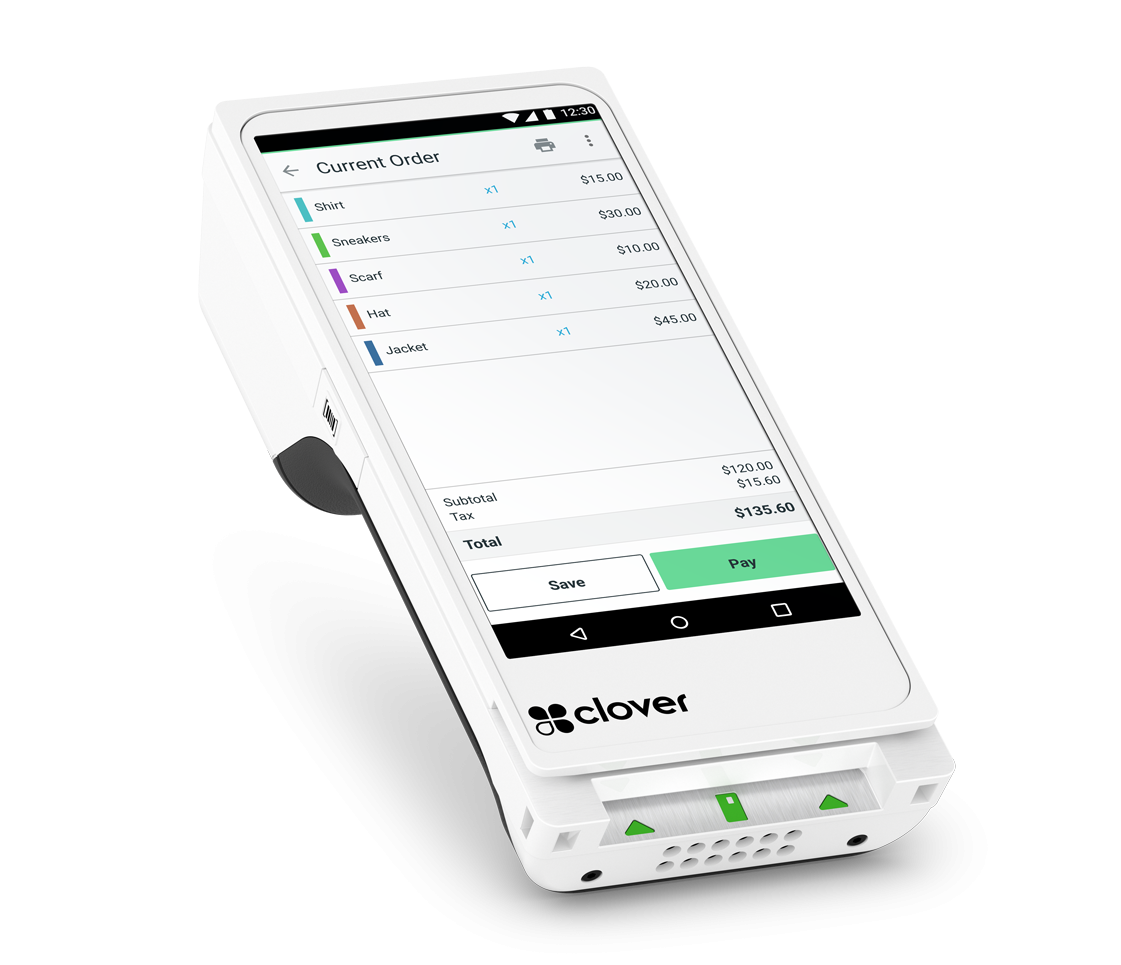
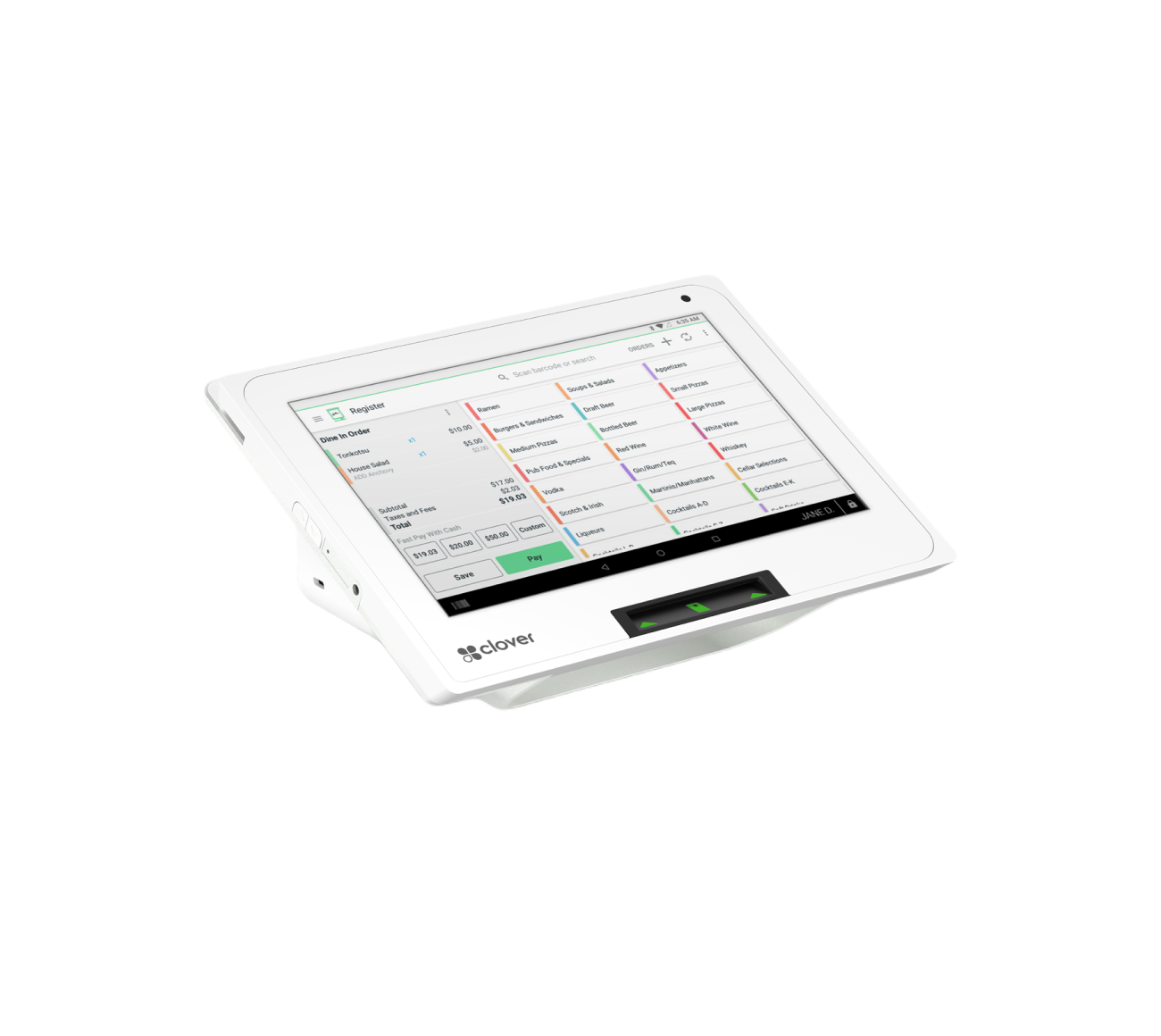
For businesses running Clover Flex handhelds or any tabletop terminal, the customer-facing display is the practical solution — the surcharge prompt appears on screen before the customer confirms the amount. A tented card at the table or a decal on the terminal itself covers the static requirement.
E-commerce and the “first page” rule
Online, the point-of-entry equivalent is the first page on your site that references credit card acceptance. Not a linked terms page. Not a footer. The disclosure has to sit on the page where the customer first learns you take cards.
The point-of-sale equivalent is the checkout page, before the customer clicks the final button that submits payment. The surcharge must be visible and labeled as a surcharge — it cannot be lumped into a generic “service fee,” “convenience fee,” or “processing fee” line that obscures what it actually is.
Phone orders, mail orders, and unattended terminals
For card-not-present transactions where the customer can’t see a screen — phone orders especially — the disclosure has to be verbal, and the customer must be given the opportunity to cancel the transaction after hearing the surcharge amount. “I’ll add 3% since you’re paying by credit, is that alright?” is a compliant script. Reading the total with the surcharge already baked in, without naming it, is not.
Unattended terminals (kiosks, fuel dispensers, vending) follow the same rule: disclose on screen before payment, with a cancel option.
What the sign actually has to say
There are three elements every surcharge notice needs:
- The surcharge percentage. The specific number you charge.
- A statement that the surcharge does not exceed your cost of acceptance. This is the network language, and it exists because the cap is tied to your actual cost, not to a flat allowance.
- A clear statement that debit cards are not surcharged. This tells the customer a fee-free option exists, and it’s the sentence that protects you when a customer complains their debit card got hit.
The standard wording the card networks circulate as a model looks like this:
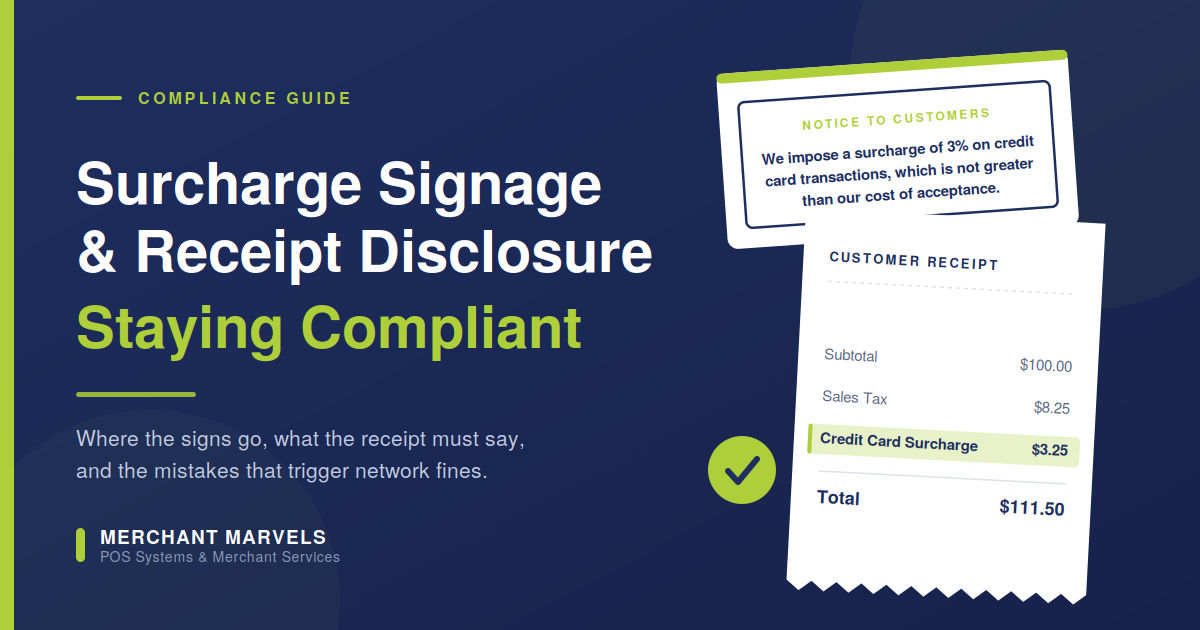
We impose a surcharge of 3% on the transaction amount on credit card products, which is not greater than our cost of acceptance. We do not surcharge debit cards.
A slightly friendlier variant that still contains all three elements:
A 3% surcharge applies to all credit card purchases. This surcharge is not greater than our cost of acceptance. Debit cards, cash, and checks are not subject to a surcharge.
Two things to avoid in your wording:
Don’t get creative with the label. Calling it a “convenience fee,” “card fee,” “processing fee,” or “non-cash adjustment” on your signage while your terminal calls it a surcharge creates an inconsistency that reads as concealment. Convenience fees are a separate, narrower category with their own rules — using that term for a surcharge is not just sloppy, it’s a different product entirely.
Don’t blame the card networks. Signs that say “due to fees imposed by Visa and Mastercard, we must add 3%” are common and are a bad idea. The surcharge is imposed by you. The networks have taken issue with disclosures that misattribute the fee, and the language invites a customer to argue with you at the counter about something you’ve told them isn’t your decision.
The receipt: where good programs quietly fail
Signage gets attention because it’s visible. Receipts get almost none, and they’re where we find the most violations when we audit an inherited account.
The rule is short: the surcharge must appear as a separate line item, expressed as a dollar amount, on every receipt — merchant copy, customer copy, printed, emailed, and texted.
A compliant receipt looks like this:
Subtotal                    $100.00
Sales Tax                     $8.25
Credit Card Surcharge         $3.25
-----------------------------------
Total                       $111.50
The customer sees the item price, the tax, the surcharge on its own labeled line, and the total. Nothing is hidden and nothing requires arithmetic.
Non-compliant versions we see regularly:
- Rolled into the subtotal. Prices silently inflated by 3% and no surcharge line anywhere. This is not a surcharge program — it’s an undisclosed price increase, and it’s the version most likely to draw a state consumer-protection complaint.
- Shown as a percentage only. “Surcharge: 3%” without the dollar figure. Mastercard’s rule specifically calls for the dollar amount of the surcharge on the receipt.
- Mislabeled. A line that reads “Fee” or “Adj” or “Svc Chg.” If a customer can’t tell what it is from the receipt alone, it isn’t disclosed.
- Present on the printed receipt, absent on the emailed one. Very common with POS systems where the email template was never updated. Both formats have to carry the line.
- Surcharge calculated on the post-tax total in a state that doesn’t allow it. Some states restrict surcharging on tax and on gratuity. If your system surcharges the grand total including a tip line, you may have a problem depending on where you operate.
One test catches nearly all of these: run a live card transaction for a small amount, on a real credit card, and look at the printed receipt and the emailed receipt side by side. Then do the same on a debit card and confirm the surcharge line is absent entirely. Most merchants never do this. It takes four minutes.
The card-network rules behind the signage
Disclosure is one piece of a larger rule set. The rest of it determines whether your disclosure is even truthful.
Caps. Visa caps credit card surcharges at 3% of the transaction. Mastercard’s published maximum surcharge cap is 4%. Because virtually every merchant accepts both, the practical ceiling is 3% — you can’t run a Visa transaction above the Visa cap. Independent of the brand caps, the surcharge can never exceed your actual cost of acceptance. If your effective rate is 2.6%, your compliant maximum is 2.6%, not 3%. Your signage says the surcharge is “not greater than our cost of acceptance,” so if it is greater, your sign is now a false statement — which turns a rate problem into a disclosure problem.
Credit only. Never debit, never prepaid. This is absolute and it’s the fastest route to a fine. A debit card run as “credit” — no PIN entered, processed down the credit rails — is still a debit card. Surcharging it violates network rules and federal law. Your POS must identify the card type by BIN in real time and drop the surcharge automatically. This is the single most important technical requirement of any surcharge program, and it’s why we won’t set one up on hardware that can’t do it reliably.
Brand-level or product-level, not both. You can surcharge every credit card of a given brand at the same rate (brand-level), or you can surcharge specific card products (product-level). You have to pick one approach per network.
Advance notice and registration. Mastercard requires notice to both Mastercard and your acquirer no less than thirty days before you begin surcharging, and provides a registration form that collects your business name and contact details, the number of locations that will surcharge, the channel (face-to-face, e-commerce, mail order, phone order), and whether you’re surcharging at the brand or product level. Visa requires notice to your acquirer on the same thirty-day timeline. This is not optional paperwork — an unregistered surcharge program is a violation on day one, regardless of how good your signage is.
Level playing field. If you accept American Express or Discover alongside Visa and Mastercard, there are additional rules about surcharging consistently across brands. You generally can’t surcharge one network and let another ride free.
Channel consistency. If you surcharge in-store, you’re expected to surcharge online too, and vice versa.
Penalties. Network fines for surcharge violations are not small, and repeat violations can end in account termination. On top of that, states impose their own — New York, for example, penalizes disclosure violations on a per-occurrence basis. The exposure isn’t a one-time fine; it’s a fine multiplied by how long you ran the program wrong.
State law sits on top of all of this
Card-network rules are the floor, not the ceiling. State law can be stricter, and where it is, it wins.
As of 2026, Connecticut and Massachusetts maintain the most consistently enforced outright bans on credit card surcharging, and Puerto Rico bans it as well. Maine’s posture remains restrictive enough that most processors treat it as off-limits. California’s statutory ban was struck down on First Amendment grounds, but the state’s Honest Pricing Law changed how mandatory fees have to be displayed, and the practical picture there is genuinely unsettled — merchants operating in California should get specific advice rather than relying on a general guide.
Among states that permit surcharging, several add requirements:
- Colorado caps the surcharge at 2%, below the network cap.
- New York requires that the customer be shown the total price they’ll actually pay, including the surcharge, before the transaction — a stricter standard than a generic percentage sign.
- New Jersey, Nevada, South Dakota, Nebraska, and Georgia limit the surcharge to the merchant’s actual processing cost.
- Minnesota restricts surcharging in certain contexts and requires the surcharge to be reflected in advertised pricing.
If you operate in one state, this is a single conversation. If you sell online across state lines, the prevailing practice is to follow the law where the buyer is located — which is why multi-state e-commerce merchants need a system that applies rules by geography, not a single global setting.
(We cover the full state-by-state picture in a separate post. If you’re deciding whether surcharging is viable where you operate, start there.)
The mistakes we see most often
Every one of these came from a real account we took over from another provider.
- One sign at the register, nothing at the door. The most common single failure. Two of the three touchpoints missing.
- Signage at the main entrance only in a business with a side entrance customers actually use.
- The percentage on the sign doesn’t match the percentage the terminal charges. Usually because the rate was adjusted later and nobody reprinted the sign.
- The surcharge exceeds actual cost of acceptance. A merchant on a 2.4% effective rate surcharging the full 3% because “that’s the maximum.” The sign says otherwise. That’s the violation.
- Debit cards getting surcharged when run as credit. Almost always a card-detection configuration problem, and almost always invisible to the merchant until a customer complains.
- Surcharge missing from the emailed receipt while the printed one is fine.
- The word “surcharge” never appears — the line says “Fee” or the sign says “non-cash adjustment.”
- No thirty-day notice filed with the acquirer, and no Mastercard registration submitted.
- Staff who can’t explain it. A cashier who tells a customer “the credit card company charges that” undermines the disclosure and creates the exact dispute the rules exist to prevent. Everyone who touches the terminal should be able to say, in one sentence, that a percentage applies to credit, that it covers processing cost, and that debit and cash avoid it.
- Surcharging in a state that doesn’t allow it, usually discovered when an online order ships to Connecticut or Massachusetts.
- Signage never updated after a location move or remodel. New door, no sign.
- Running a surcharge program when a cash discount program would have been the better fit. Surcharging carries registration, signage, and receipt obligations that a properly built cash discount program does not. For a brand-new business with no established price list, dual pricing is often the cleaner route — the listed price is the card price, cash customers receive a discount, and there’s no surcharge line to get wrong.
What compliant setup looks like on day one
Here’s the sequence we run for a new surcharge merchant:
- Confirm surcharging is permitted where the business operates, and identify any state-specific cap or disclosure rule
- Pull the effective processing rate and set the surcharge at or below actual cost of acceptance
- File the thirty-day notice with the acquirer and complete the Mastercard registration
- Configure the terminal for real-time BIN detection so debit is excluded automatically, with no manual step for staff
- Configure the receipt template — printed and electronic — with the surcharge as a labeled dollar-amount line
- Print and place point-of-entry signage at every customer door and point-of-sale signage at every register and terminal
- Run live test transactions on a credit card and a debit card, and check both receipt formats
- Train staff on the one-sentence explanation
- Re-check signage and receipt formatting any time the rate, the location, or the POS configuration changes
None of this is difficult. All of it is easy to skip, and skipping it is what turns a savings program into a liability.
We provide compliant signage and setup from day one
At Merchant Marvels, surcharge compliance isn’t an add-on — it’s part of how we place every account. Your Clover system arrives configured to detect debit in real time and exclude it automatically, your receipt templates are set up with the surcharge as a properly labeled line item, and your point-of-entry and point-of-sale signage comes with the equipment, with the correct percentage and the correct language already on it. We handle the thirty-day notice and network registration, and we check the rules for the state you actually operate in before we turn anything on.
If surcharging isn’t the right fit for your business, we’ll tell you that too, and set you up on a cash discount program instead.
We provide compliant signage and setup from day one. Give us a call and we’ll walk through your current program — or build you a new one that holds up.
Merchant Marvels provides POS systems and merchant services to businesses nationwide. This article is general information, not legal advice. Surcharge regulations vary by state and change frequently; consult your attorney regarding your specific situation.