A practical guide to restaurant credit card processing fees, surcharging, dual pricing, and building a table-side setup that protects your margin.
Ask a restaurant owner to name their three biggest expenses and you’ll hear food cost, labor, and rent. Ask about number four and the room goes quiet — because for most full-service and fast-casual operators, number four is payment processing, and almost nobody has ever seen it broken down clearly.
Restaurant credit card processing fees typically run between 2% and 3% of total card volume, and a busy dining room can process 85% to 95% of its sales on cards. Run the math on a restaurant doing $80,000 a month: at 2.6% effective on 90% card volume, you’re paying roughly $1,870 a month — about $22,400 a year — to move money you already earned. On a 4% net margin, that single line item can be the difference between a good year and a flat one.
The good news is that restaurant credit card processing fees are one of the few costs in this business you can actually restructure. You can’t negotiate the price of beef. You can absolutely restructure how card acceptance gets paid for.
The catch is that restaurants are the hardest vertical to do it in. Retail has one price and one transaction. Auto shops have big tickets and few of them. A restaurant has tips, split checks, tip adjustments, table turns, delivery apps, and a guest experience that a clumsy fee can genuinely damage. This post covers how to cut restaurant credit card processing fees without putting a dent in your reviews — and what equipment you need for it to actually work at Friday-night volume.
Why restaurant processing costs more than owners expect
Before you fix the number, it helps to understand why it’s higher in restaurants than in most other card-present businesses.
You pay a fee on the tip. This is the one that catches operators off guard every time. When a guest leaves a $20 tip on a $100 check, the transaction settles at $120 — and your processor takes its cut of the full $120. That’s roughly $0.52 in fees on money that goes straight to your server and never touches your P&L. Across a year, a restaurant with 18% average tipping is paying processing on nearly a fifth of its card volume for revenue it never keeps.
This has become a live legislative issue. Starting in July 2026, Illinois prohibits charging interchange fees on the tax and gratuity portions of a transaction where the acquiring bank is notified during authorization or settlement, and Delaware’s House Bill 315 would separate credit card fees on tips from fees on sales. Other states are watching. But until those rules are widespread and actually implemented at the processor level, the tip is part of your fee base.
Tip adjustment can downgrade your transactions. In the traditional workflow, your server runs the card for the check amount, brings back a slip, the guest writes in a tip, and you adjust the total before batching. That adjustment happens after authorization. Depending on your pricing model and how quickly you batch, adjusted transactions can settle at less favorable rates than the original authorization — a real cost that never appears as a line item you’d recognize. It just makes your effective rate quietly higher than the rate you were quoted.
Your card mix skews toward premium credit. Guests dining out are more likely to reach for a rewards card than someone buying gas. Rewards and premium cards carry higher interchange, and the difference between a basic debit card and a premium travel card on a $150 check can be over a dollar.
Delivery and online ordering stack fees on fees. Third-party marketplaces already take 15% to 30%. Your own online ordering channel, if it’s card-not-present, carries higher interchange plus a per-authorization fee for keyed and e-commerce transactions.
Nobody reads the statement. Restaurant owners are the most time-poor merchants in America, and processors know it. Rate increases, new “network access” line items, PCI non-compliance fees, and monthly minimums accumulate on statements that never get opened. If you can’t say your effective rate off the top of your head — total fees ÷ total card volume, for one month — that number is almost certainly higher than you think.
Find your real number first. Pull last month’s statement. Take every fee, every line, and divide it by your gross card volume. That’s your effective rate. Everything in this post is measured against that figure.
The three ways to respond
Once you know your effective rate, there are only three honest options.
Absorb it. This is what most restaurants do by default. It’s clean and invisible to guests, and it costs you the full amount every month, forever.
Raise menu prices across the board. Also common, and it works — but it’s blunt. You’re raising the price for the cash guest and the card guest equally, and a menu-wide 3% bump is exactly the kind of change that price-sensitive regulars notice. One industry observation is that customers watch menu prices closely, which is part of why some operators prefer to show the cost of card acceptance directly rather than folding it into the menu.
Shift the cost of card acceptance to the guests who choose to pay by card. This is the surcharge and dual pricing family, and it’s where most of the savings live. It’s also where the compliance risk lives, which is why it needs to be set up properly rather than switched on by whoever answers your processor’s support line.
Surcharging in a restaurant: what works and what breaks
A surcharge is a percentage added to a credit card transaction to offset your cost of acceptance. It’s legal in most of the country and it’s the most direct way to cut restaurant credit card processing fees to near zero. But the rules are specific, and restaurants trip over several of them.
Credit only. Never debit. Debit and prepaid card transactions cannot be surcharged in any state — federal law and card network rules prohibit it nationwide. This matters more in restaurants than almost anywhere else, because a meaningful slice of your guests are paying with debit. Your system has to detect card type automatically at the moment of the transaction. Any setup that adds a flat percentage to every card is not a surcharge program, it’s a violation waiting for an audit.
The cap is the lesser of 3% or your actual cost. Visa caps credit surcharges at 3% and Mastercard at 4%, and the surcharge can never exceed your actual cost of card acceptance — whichever number is lower governs. Since you accept both brands, 3% is the practical ceiling. Visa has publicly designated 2026 as a high-enforcement year, meaning audits and fines are up.
You have to notify your acquirer in writing 30 days before you start. The notice includes your business name and address, whether you’re surcharging at brand level or product level, the surcharge amount, and any third party involved. You also have to pick brand-level or product-level surcharging — not both.
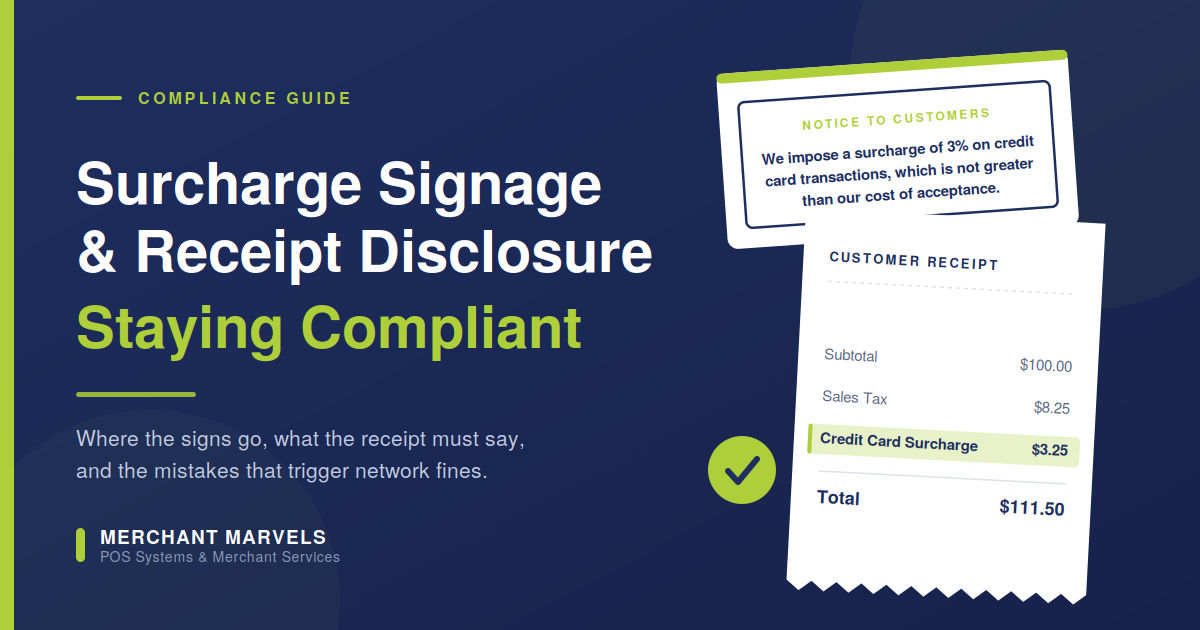
Disclosure is not optional and it’s not one sign. Where surcharging is legal, disclosure is required everywhere: signage at the point of entry, notice at the point of sale, and a separate line item on every receipt. In a restaurant that means the front door, the menu, the host stand, your online ordering page, and the printed check — not just a card taped to the POS screen the guest never sees.
State law still governs. As of 2026, Connecticut, Massachusetts, Maine, and Puerto Rico enforce outright bans on credit card surcharges. Several others — Colorado, New York, New Jersey, and Nevada among them — allow surcharges only under specific conditions. New York requires you to post the total price a card-paying customer will actually pay. Minnesota’s HF 3438 amended its Deceptive Trade Practices Act to make it illegal to add mandatory charges at the end of a transaction, though restaurants and hotels can still apply mandatory gratuity where the revenue goes to employees and the percentage is clearly disclosed alongside pricing, with violations carrying fines of up to $25,000.
And the restaurant-specific one: don’t surcharge the tip. The surcharge is there to recover your cost of accepting the card for the sale. It should be calculated on the pre-tip subtotal, disclosed before the guest commits, and the tip should be added on top of a total the guest has already seen. Applying a percentage on top of a gratuity is the fastest way to turn a fee your guests would have tolerated into a screenshot on social media. Your POS has to be configured to sequence this correctly — this is not something you fix with staff training.
Cash discount and dual pricing: often the better fit for dining
There’s a second model, and in restaurants it’s frequently the stronger one.
Under a cash discount or dual pricing program, your menu price is the card price. Guests who pay cash receive a discount at the register. Nothing is added at the end of the transaction — something is taken off.
For restaurants, this solves several problems at once:
- It covers debit too. Because you’re not surcharging anything, the debit restriction doesn’t apply. Every card transaction is priced the same way, which is a real advantage in a business where debit share is high.
- It’s legal in all 50 states. Cash discount programs are legal nationwide and don’t trigger the surcharge rules. If you operate in multiple states, or in one of the four that ban surcharging, this is the route.
- It reads better to guests. Consumers respond more positively to a “cash discount” than to a “credit penalty,” and retailers and restaurants benefit most from dual pricing because of the high volume of small, face-to-face transactions.
- It sidesteps the tip problem entirely. There’s no percentage riding on top of the check total, so there’s no awkward interaction between the fee and the gratuity.
The trade-off is that dual pricing means touching your menu. Every price moves up by roughly 3%, and both prices need to be visible. That’s straightforward if you’re opening, rebranding, or already due for a reprint — and it’s an argument for waiting until your next menu cycle if you’re not.
Which one fits your restaurant
| Surcharge program | Cash discount / dual pricing | |
|---|---|---|
| Best for | Established restaurants not ready to reprint menus | New openings, rebrands, or menus due for reprint |
| Applies to debit | No — credit only, by law | Yes — all card types priced the same |
| State coverage | Most states; banned in CT, MA, ME, PR | All 50 states |
| Menu changes | None required | Prices raised ~3%, cash price shown alongside |
| Guest perception | A fee added at the end | A discount offered for cash |
| Acquirer notice | 30 days’ written notice required | Not required |
| Tip interaction | Must be configured to exclude gratuity | No interaction |
A simple rule of thumb: if you’re already open and running, surcharging is usually the faster path. If you’re opening or reprinting, dual pricing is usually the better one.
The part most operators get wrong: keeping the customers
Cutting restaurant credit card processing fees is a solved technical problem. Doing it without losing guests is a hospitality problem, and it’s where these programs succeed or fail.
Disclose early and everywhere. The guest who’s annoyed is almost never annoyed about 3%. They’re annoyed about being surprised at the end of a meal they’ve already eaten. Door decal, host stand, footer on every menu page, checkout page on your online ordering, line on the printed check. Surprise is the enemy, not the fee.
Give your staff one sentence. Not a policy, not an explanation of interchange. One sentence they can say naturally: “There’s a small card fee on credit — it comes off if you’d rather pay cash or debit.” Then stop talking. Servers who over-explain make guests suspicious. Servers who apologize make guests think something is wrong.
Round your prices. If you’re on dual pricing, don’t put $18.54 on the menu. Move to $18.50 or $19.00. Ugly numbers signal a formula, and guests who spot the formula start doing math instead of ordering dessert.
Never surcharge debit, and never surcharge the tip. Both are compliance issues and both are the specific things guests notice and complain about publicly.
Give your manager comp authority. Budget for it. If a guest genuinely objects, the fee comes off, the manager smiles, and the interaction is over in ten seconds. The cost of comping the rare complaint is a rounding error against what you’re saving; the cost of a manager arguing at table twelve is a one-star review.
Expect a small, front-loaded reaction. Operators who do this well report that pushback concentrates in the first two or three weeks, from regulars, and then largely disappears. Warn your regulars personally before you flip the switch. A heads-up from the owner lands very differently than a sign they discover on the way out.
Table-side payments and why your equipment decides all of this
Here’s what ties the whole thing together: none of the above works reliably if your hardware can’t execute it.
A surcharge program requires real-time card-type detection at the moment of payment. A dual pricing program requires two prices to display and print correctly. Both require a receipt that itemizes properly. And in a restaurant, all of it has to happen at the table, during a rush, in front of the guest, without slowing a turn.
Pay-at-table changes the economics on its own. When the guest taps or dips at the table and enters the tip on the device, several things happen at once:
- The tip adjustment goes away. The transaction authorizes and captures at the final amount, including gratuity. No adjustment, no batch-time surprises, no downgrade risk from adjusted transactions.
- The card never leaves the guest’s hand. That’s a meaningful reduction in disputes and in the “I never authorized this” category of chargebacks — and chargebacks in restaurants are expensive relative to ticket size.
- Tips generally go up. A tip screen with clear prompts consistently outperforms a handwritten line on a paper slip.
- You turn tables faster. Cutting two trips to the POS out of every check adds up over a 200-cover night.
- Your fee disclosure happens on-screen, in front of the guest, before they commit. That’s exactly what the card brand disclosure rules want, and it’s exactly what stops guests feeling ambushed.
High volume needs the right layout, not just the right device. A single terminal at the host stand is a bottleneck at 7:30 p.m. A working restaurant setup usually means a main station where checks are built and reports are pulled, handhelds for the floor, and kitchen routing so orders fire without anyone walking a ticket back. Get this wrong and you’ll blame the payment program for problems the layout caused.
The Clover equipment placement program with Merchant Marvels
This is where we come in, and I want to describe it plainly, including the parts other people leave out of the pitch.
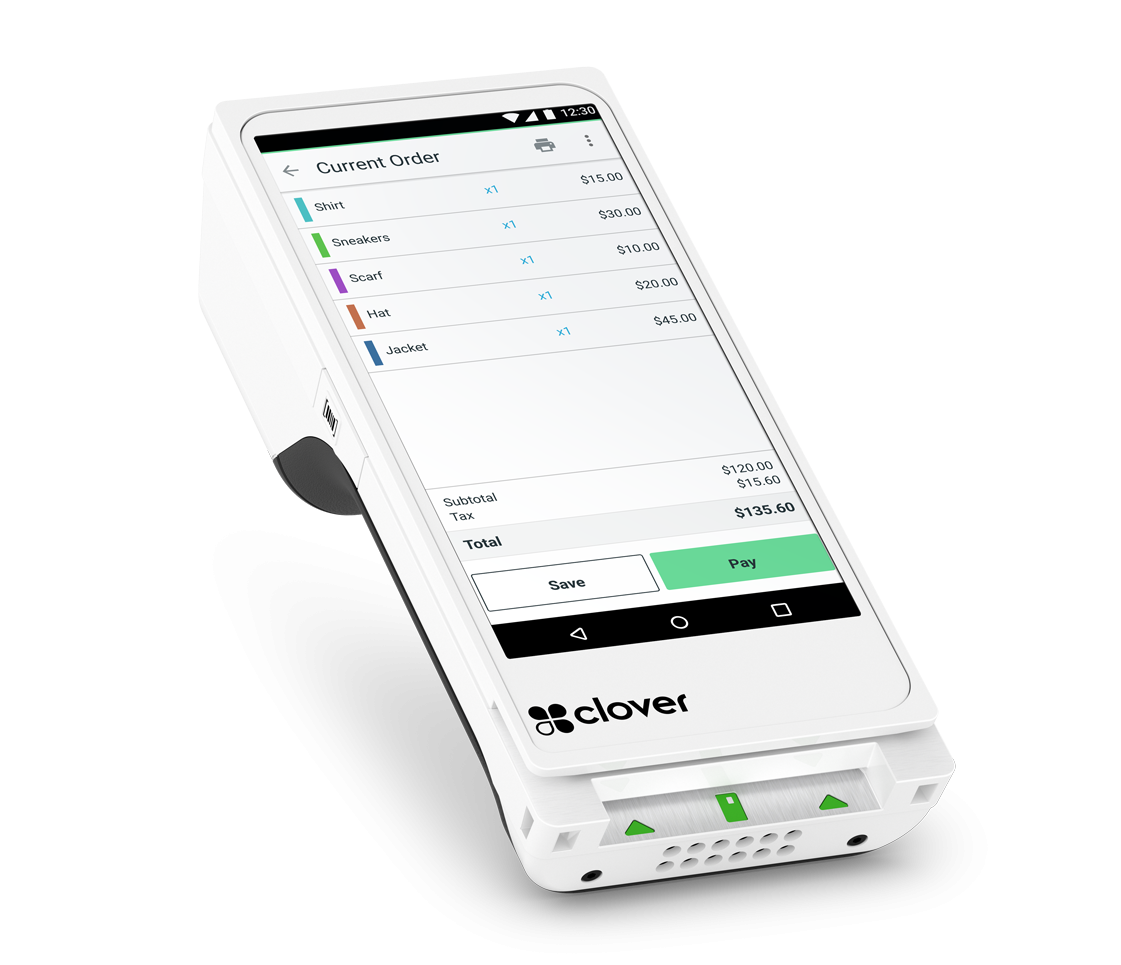
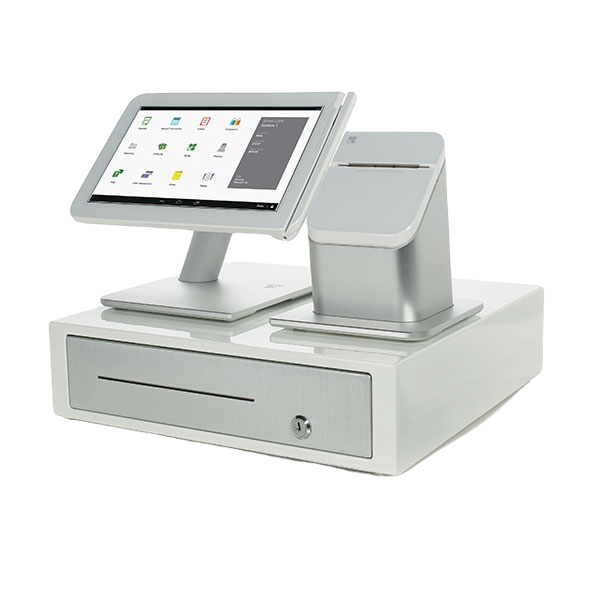
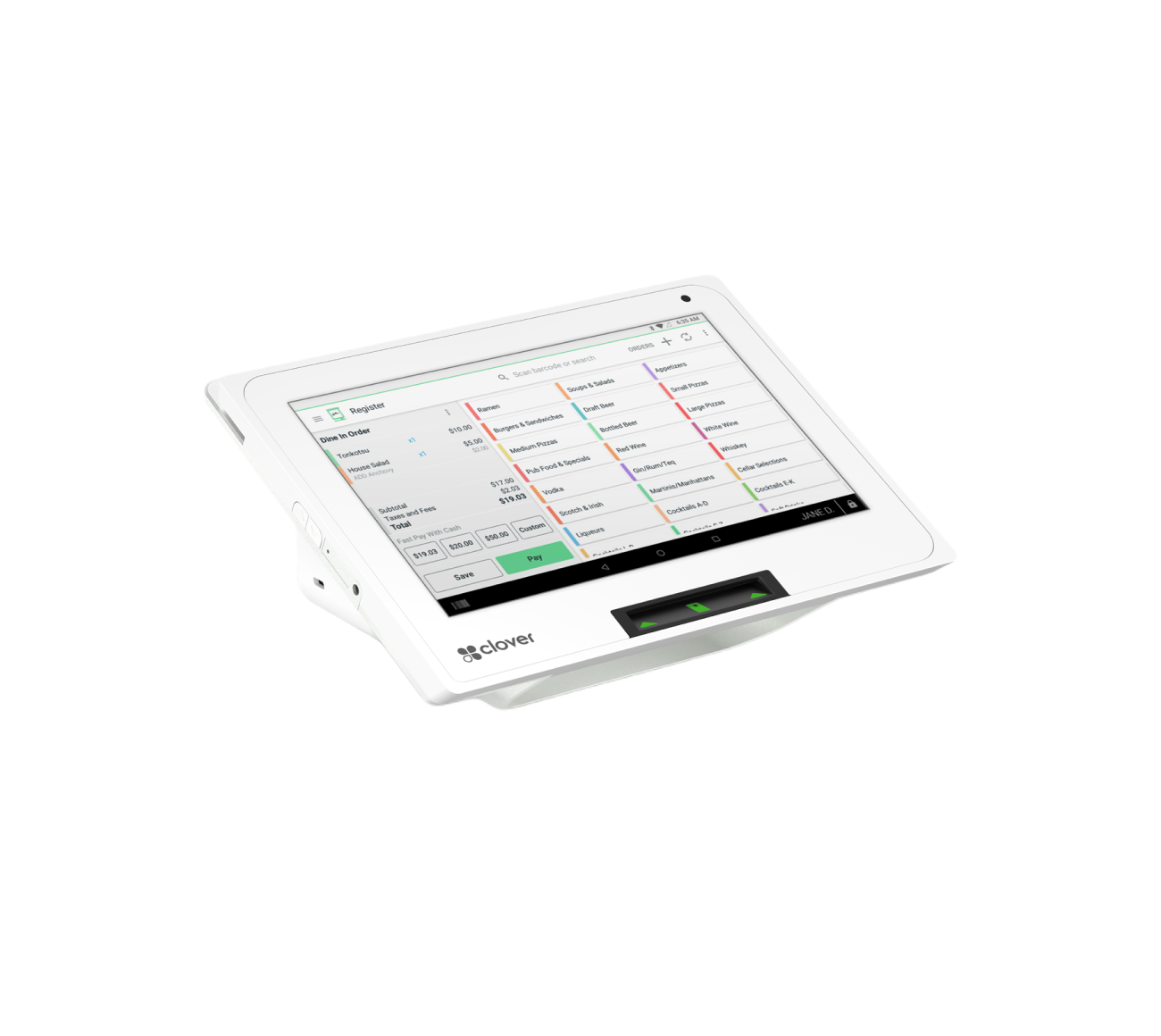
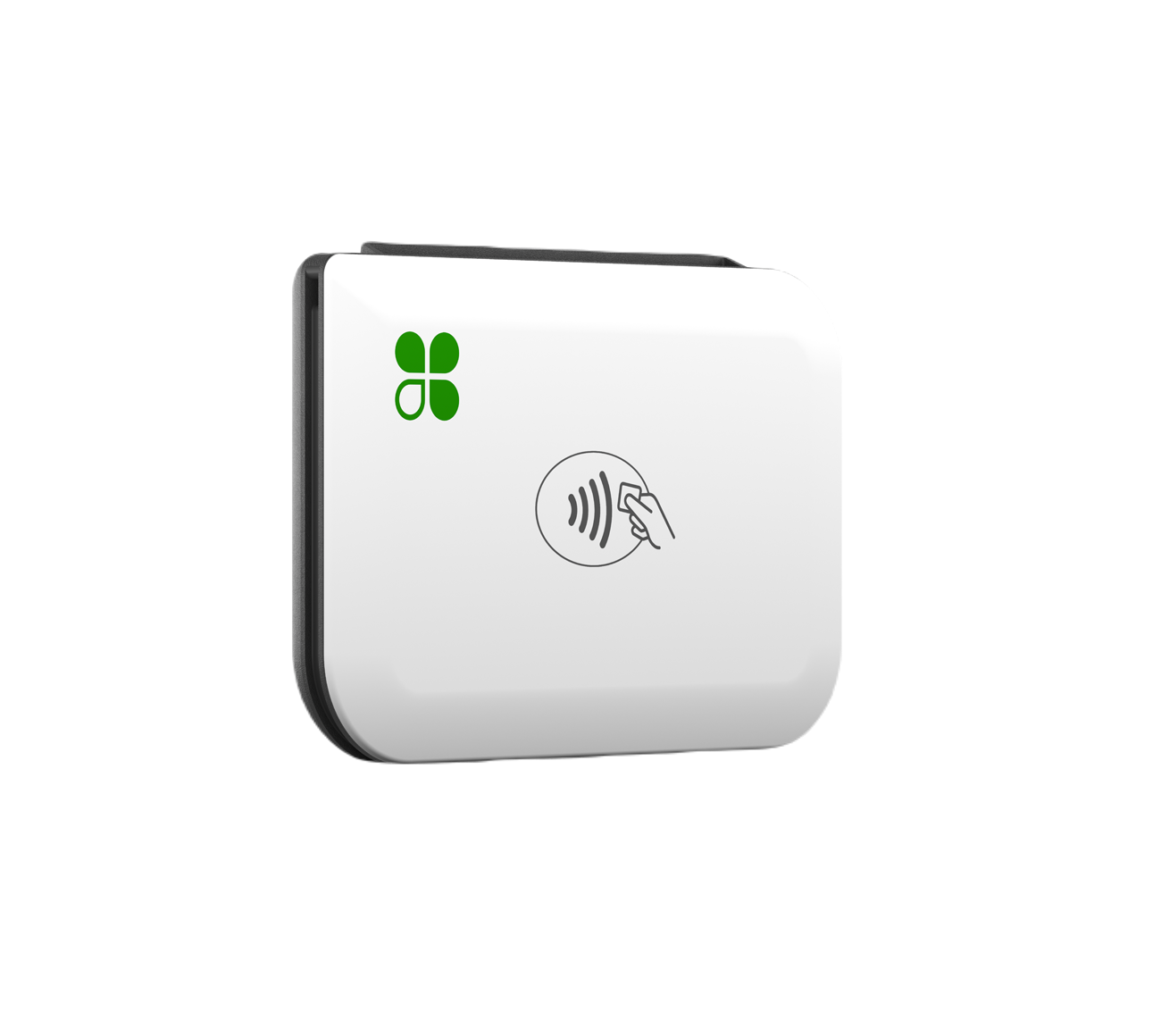
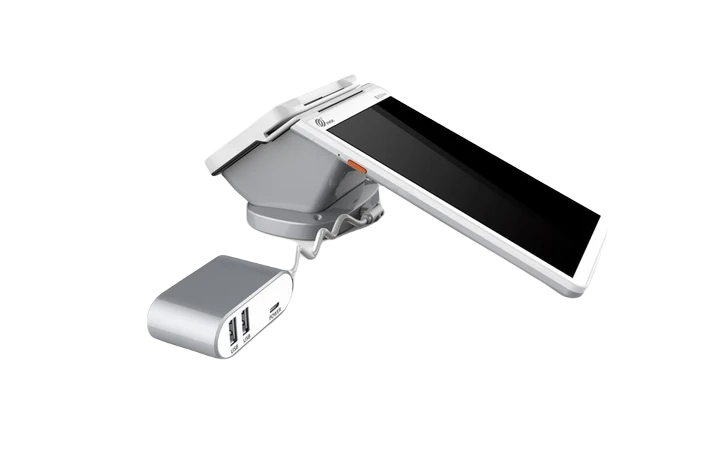
What we place. Through our equipment placement program, Merchant Marvels places a Clover Station Duo — the full setup with cash drawer — in your restaurant at no upfront cost, no rental cost, no contract, and no cancellation fee. Clover Flex handhelds handle the floor: they take chip, tap, and mobile wallets, they have a built-in printer and scanner, and they run tip prompts and your fee program at the table. Kitchen displays and thermal kitchen printers can be added so orders route straight to the line.
What it costs monthly. Two separate bills, and I’d rather you know that now than find out in month two:
- Merchant services side: a $20/month service fee plus $10/month for Clover TransArmor device security, debited by the processor in the first week of each month.
- Clover software side: billed separately by Clover, mid-month. Restaurants running a kitchen display or kitchen printer need Clover’s Restaurant Growth plan — at the time of writing $89.95/month for the first device, with additional devices at $19.95 each.
Your total depends on how many stations and handhelds you run and which plan your setup requires. We quote it in full, in writing, before you sign anything.
What “free equipment” honestly means. The hardware stays yours to use for as long as you’re processing with us, with nothing paid upfront and no obligation to stay. It is not a giveaway — placed equipment remains the property of the placing company and comes back if you cancel. Anyone telling you that you keep a $2,400 POS system for free is setting you up for a surprise later. The placement program covers one terminal; additional stations are available at a monthly rate.
What we cover out of pocket. The bank charges $99 for overnight shipping on placed equipment. We ship ground and reimburse that fee ourselves. If the bank ever bills equipment shipping or handling to you instead of to us — which happens occasionally — we reimburse that too.
Configured compliant on day one. Your system arrives programmed for whichever program you choose. On surcharging: credit-only, automatic card-type detection so debit is never surcharged, correct 3% application, gratuity handled properly, receipts itemized the way the card brands require, and the 30-day acquirer notice filed for you. On dual pricing: both prices printing correctly on checks and receipts. We handle the state rules for wherever you operate, and we supply the signage.
Support that answers. 24/7 live support runs on the Clover device itself. And since we operate remotely and serve restaurants in all 50 states, we’re not a rep who signs you and disappears — you have a direct line to us.
A realistic 30-day rollout
- Days 1–3 — Find your number. Send us a recent statement. We calculate your effective rate and show you the real dollar figure you’re paying, including what you’re paying on tips.
- Days 3–7 — Pick the program. Surcharge or dual pricing, based on your state, your menu cycle, and your debit mix. This is a conversation, not a form.
- Days 7–10 — Application and acquirer notice. We file the 30-day surcharge notice if that’s your route. Nothing goes live before that clock runs out.
- Days 10–14 — Hardware ships. Station, handhelds, kitchen routing. We build your menu, modifiers, and floor layout with you.
- Days 14–21 — Signage and staff. Door, host stand, menus, online ordering. Your servers get the one sentence and a chance to practice it.
- Days 21–30 — Go live and watch. First two weeks are the noisy ones. We stay close, check the first statements line by line, and adjust anything that isn’t landing right.
Frequently asked questions
Will I lose customers over a card fee? Some operators see a handful of complaints in the first two weeks, concentrated among regulars, and then it settles. What actually drives guests away is being surprised — not the percentage. Disclose early, train one sentence, and give your manager authority to remove it on request.
Can I surcharge the tip? You shouldn’t. The surcharge should be calculated on the pre-tip subtotal and disclosed before the guest commits. It’s a configuration issue, and it’s one of the things we set correctly before your system ships.
Can I surcharge debit cards? No. Debit and prepaid transactions cannot be surcharged in any state under federal law and card network rules. If you want a program that covers debit too, dual pricing is the answer.
What if I’m in a state that bans surcharging? Then you run a cash discount or dual pricing program instead. Cash discount programs are legal in all 50 states and don’t trigger the surcharge rules.
How much can a restaurant actually save? It depends on your effective rate and card mix, but a properly built program is designed to reduce your processing cost dramatically — on credit transactions under a surcharge program, close to eliminated. We’ll show you the specific number from your own statement rather than a generic promise.
Do I really pay nothing for the equipment? Nothing upfront, no rental, no contract, no cancellation fee. You pay the monthly service and software fees described above, and the placed equipment returns to us if you stop processing with us.
I’m on Toast/Square and I’m locked in. Is it worth looking? Worth a conversation at minimum. Integrated systems bundle hardware, software, and processing together, which is convenient right up until you want to change the processing half. Bring us a statement and we’ll tell you honestly whether switching pencils out for you — including if it doesn’t.
The bottom line
Restaurant credit card processing fees are the fourth-largest expense in most dining rooms and the only one of the four you can restructure this quarter. The tools are legal, the rules are clear if you follow them, and the guest reaction is manageable when the program is disclosed properly and executed on hardware built for a restaurant floor.
What sinks operators isn’t the fee. It’s a program bolted onto equipment that can’t detect a debit card, a surcharge sitting on top of a gratuity, a sign nobody sees until the check arrives, and a server who has to improvise an explanation at table twelve.
Set it up right and your guests barely register it. Set it up wrong and you’ll spend a year undoing it.
Ask about restaurant setups built to protect your margins. Send us a recent statement and we’ll show you exactly what you’re paying today, what your setup would look like, and what the switch would actually save you — with the Clover hardware placed at no upfront cost, no contract, and no cancellation fee.
Merchant Marvels provides POS systems and merchant services to businesses in all 50 states. This article is general information, not legal advice — surcharge and dual pricing rules vary by state and change frequently, and we’ll confirm the specific requirements that apply where you operate before anything goes live.