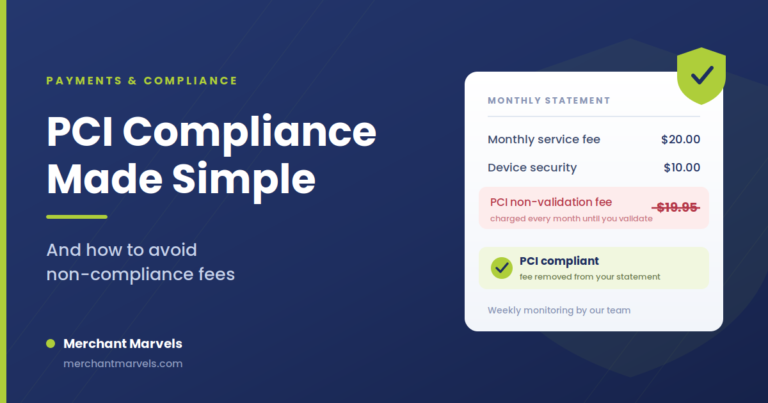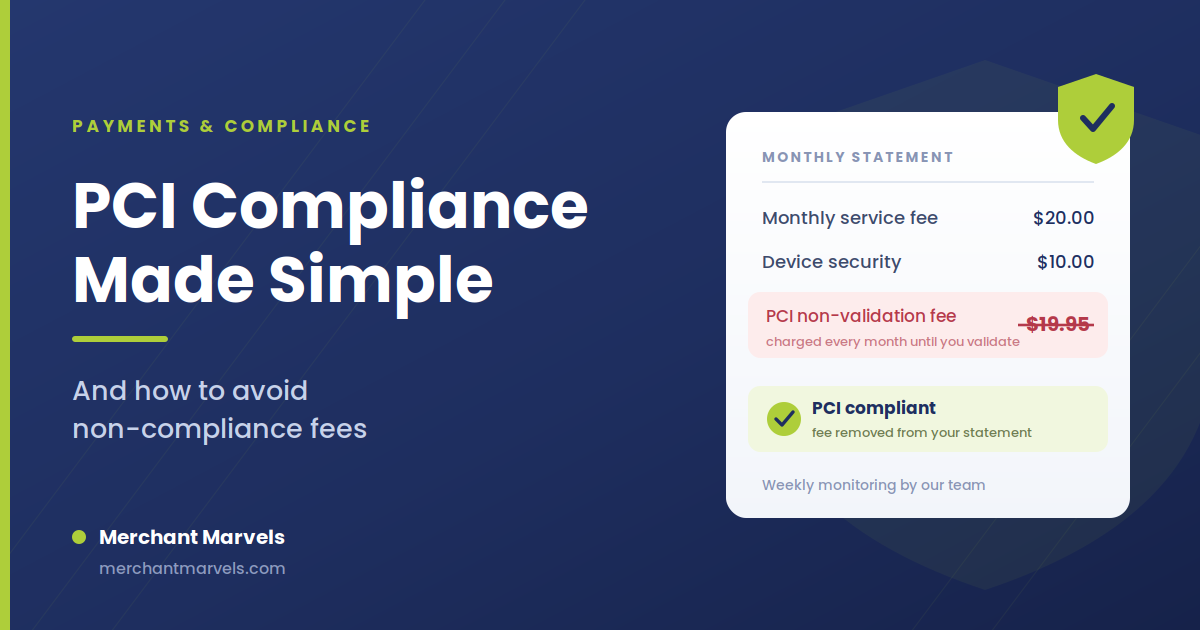
Somewhere on your monthly processing statement there may be a line item you have never looked at closely. It might be called a “non-validation fee,” a “PCI non-compliance fee,” or something equally forgettable. It is usually small. Twenty dollars, give or take. And because it is small, most business owners scroll past it for months, sometimes years, before someone finally asks what it is.
That line item is a fine. It is charged because a form has not been filled out.
That is the frustrating part of PCI compliance for small business owners. The penalty is rarely for being unsafe. It is almost always for not having told anyone that you are safe. The fix usually takes twenty to forty minutes once a year. The fee for skipping it runs every single month until you do.
This guide explains what PCI compliance actually is, what the self-assessment involves, why non-compliance fees are more expensive than they look, and how to get compliant and stay that way without turning it into a project. And because we do this for our merchants every week, we will also show you exactly what that support looks like.
What PCI Compliance Actually Is
PCI stands for Payment Card Industry. The full name of the standard is the Payment Card Industry Data Security Standard, usually shortened to PCI DSS.
It is a set of security rules that applies to any business that stores, processes, or transmits payment card data. It does not matter whether you run twelve locations or one food truck. If you take cards, the standard applies to you.
The standard is written and maintained by the PCI Security Standards Council, an organization formed by the major card brands. Here is the part that confuses people: PCI DSS is not a government regulation, but compliance is effectively required, because payment processors and acquiring banks enforce it as a condition of accepting card payments.
So no police officer is going to knock on your door. Your processor, however, has a contract with you, and that contract says you will validate compliance. When you do not, the contract gives them the right to charge you a fee, and eventually to hold you responsible for the cost of a breach.
The council publishes the standard but does not fine merchants directly. Enforcement runs through Visa, Mastercard, American Express, and Discover via their compliance programs, and those costs flow down through your acquiring bank to you.
Does it apply to a small business?
Yes. There is no revenue floor and no exemption for small volume.
What does change with volume is how you prove compliance. Card brands sort merchants into levels based on annual transaction counts. The largest merchants, processing millions of transactions a year, must bring in an outside auditor called a Qualified Security Assessor. The overwhelming majority of small and mid-size businesses fall into the smallest level, and they are allowed to validate compliance themselves.
That is the good news. For small businesses, the standard is most commonly encountered through a Self-Assessment Questionnaire, or SAQ, which maps your payment environment to the specific requirements you need to meet. You answer questions about how you take payments, you attest that your answers are true, and you are done for the year.
What the Standard Actually Asks For
PCI DSS is built around twelve core requirements. Reading them raw is not pleasant. Translated into plain English for a typical retail shop, restaurant, or salon, they come down to a handful of habits:
Protect the card data itself. Do not store full card numbers in a spreadsheet, a notebook by the register, or a folder of emailed order forms. Do not write down security codes. If you never store it, you cannot lose it.
Use secure equipment and keep it updated. Your terminal, POS system, and any computer connected to them should be running current, supported software with security patches applied.
Change the default passwords. This is the single most common failure in small business environments. Routers, terminals, and back office systems ship with factory passwords that are published online. Change every one of them.
Restrict who can get to what. Each employee gets their own login on the POS. No shared manager code taped under the counter. When someone leaves, their access leaves with them.
Lock down your network. A firewall on your business internet connection, and a separate guest Wi-Fi network for customers that cannot reach the network your payment devices sit on.
Watch your physical devices. Card skimmers are physically attached to terminals by people who walk into the store. Inspect your equipment. Know the serial numbers. Train staff to notice when something looks different.
Have a written policy and an incident plan. A short document saying who is responsible for what, and what happens if you suspect a compromise.
None of that is exotic. Most of it is what a reasonably careful business is already doing. The compliance process is largely about confirming it in writing.
What Changed Recently, and Why It Matters in 2026
If you last looked at PCI a few years ago, the ground has shifted. Version 3.2.1 was retired in 2024, and all assessments conducted in 2026 are against PCI DSS v4.0.1. Since 31 March 2025, the requirements that were previously labeled “future-dated” best practices are mandatory, and every requirement is now in scope.
Three changes matter most for small merchants:
Multi-factor authentication is broader than it used to be. It now covers administrative access to systems that touch card data, including the portals and dashboards you log into rather than only servers you host yourself.
Password rules tightened. Longer minimum lengths, with documented exceptions where older systems cannot support them.
E-commerce payment pages have new script rules. Requirements 6.4.3 and 11.6.1 exist to protect online payment pages from e-skimming and script tampering, the kind of attack that injects malicious code into a checkout page to steal card data. If you run an online store, this is the change most likely to affect you. Whether these apply depends on how you validate: merchants using SAQ A-EP or SAQ D are in scope, while merchants using SAQ A, with a fully outsourced payment page they do not control, are not.
The broader shift is philosophical. PCI used to be treated as an annual box to tick. The current version pushes merchants toward maintaining continuous evidence of security controls across the twelve requirements rather than a single point-in-time validation once a year.
The Self-Assessment, Step by Step
Here is what the process actually looks like when you sit down to do it.
1. Log into your compliance portal. Your processor gives you access to one, usually through the same provider that handles your merchant account. If you cannot find the login, ask your agent. This is where most people stall out, and it is a five-minute problem.
2. Answer the scoping questions. The portal asks how you accept payments: card present with a terminal, e-commerce, over the phone, or some combination. Your answers determine which questionnaire you get.
3. Get matched to an SAQ. There are several versions, and the one you receive dramatically changes how much work you are signing up for:
- SAQ A covers card-not-present merchants who have fully outsourced their payment page to a compliant third party, with no card data touching their own systems. It is the shortest.
- SAQ A-EP applies when your payment page sits partly on infrastructure you control. This includes cases where scripts or redirects run on domains you own.
- SAQ B and B-IP cover terminals with no card data stored electronically, either dial-out or IP-connected.
- SAQ C and C-VT cover payment applications connected to the internet, and web-based virtual terminals.
- SAQ P2PE applies when you use a validated point-to-point encryption solution, and it is one of the shortest questionnaires available.
- SAQ D is the long one, and it is where you land if nothing else fits.
There is a widely believed myth worth flagging here. Merchants often assume that using a hosted checkout automatically covers them, but eligibility is precise: if your checkout page loads a single analytics tag, a retargeting pixel, or any script from your own domain, your scope changes, and so does your SAQ.
4. Answer the questions honestly. Each one is a yes or no about a control being in place. If the answer is no, fix it before you attest, not after.
5. Run a network scan if you need one. Merchants with internet-connected payment systems generally need a quarterly scan from an Approved Scanning Vendor. It runs from the outside and looks for known vulnerabilities on your public-facing IP address. Most compliance portals bundle this.
6. Sign the Attestation of Compliance. This is a formal statement to your acquiring bank. Treat it seriously. Attesting to controls you have not implemented is not a paperwork slip. It is a false statement in a contractual relationship, and it can void the protections you were counting on if a breach ever happens.
7. Diary the renewal. Validation is annual. Twelve months later, you do it again.
Why Non-Compliance Fees Hurt More Than You Think
The direct cost is easy to underestimate because it is designed to be. Missing the deadline triggers automated non-compliance fees, typically $20 to $80 per month, until you submit.
On the programs we place merchants on, the specifics are clear: you have 60 days from account opening to validate, and after that a $19.95 monthly non-validation fee applies until you do.
Run that out. Twenty dollars a month is $239.40 a year. Three years of ignoring an email is over seven hundred dollars, spent on nothing. No service. No equipment. No protection. It is pure leakage, and it is the easiest money in your entire cost structure to stop spending.
Now the part that costs real money.
The fee is not the punishment. The fee is the warning. What sits behind it is liability.
If your business suffers a card data compromise while you are not compliant, the financial picture changes completely. You can be responsible for the cost of a forensic investigation, which for a small merchant frequently runs into five figures. You can be assessed card brand fines, passed down through your acquirer. You can be liable for the cost of reissuing every card that passed through your business during the exposure window, and for fraud losses on those cards. In serious cases your merchant account can be terminated and your business placed on the MATCH list, an industry blacklist that makes getting a new processor very difficult for five years.
There is also the ordinary business damage: the customers who read the local news story, the online reviews that mention it for the next two years, and the staff hours you spend on the phone with investigators instead of running the shop.
Compliance is not a guarantee against any of that. But being compliant, and being able to prove it with a current attestation, is the difference between a defensible position and an indefensible one. Many processors also offer breach protection programs that only pay out if you were validated at the time of the incident. If you were not, the safety net is not there.
How to Stay Compliant Without Losing a Weekend
For a typical small business, this is the whole job:
Complete the SAQ once a year, honestly. Run your quarterly scan if your setup requires one. Change every default password on every device on your network, including the router. Give each employee an individual login. Put customers on a separate guest Wi-Fi. Keep your terminals and POS software updated. Stop storing card numbers anywhere, on paper or on screen. Inspect your physical devices for tampering on a regular schedule. Write down a one-page security policy. Set a calendar reminder 30 days before your validation expires.
That is roughly an hour a year, plus a few habits. The reason so many merchants pay the fee anyway is not laziness. It is that the notice arrives as an email from a processor they have no relationship with, the portal login is buried, the questionnaire uses language nobody outside of information security speaks, and there is no one obvious to call. So it sits. And the fee starts.
That specific failure is what we built our process around.
How Merchant Marvels Keeps You Compliant
We treat PCI as our job, not yours.
Weekly monitoring of your compliance status. Our team reviews the PCI status of every merchant on our books each week. We are not waiting for a fee to appear on your statement to notice a problem. If your validation is incomplete, expiring, or has lapsed, we see it within days.
A phone call, not an email you will ignore. When a merchant shows as non-compliant, we call. A real person from our team walks you through the portal, explains what each question is asking in plain language, and stays on the line until the attestation is submitted. Most merchants finish in a single call.
We get you compliant inside the 60-day window. New accounts have 60 days to validate before the $19.95 non-validation fee starts. We track that clock from the day your account opens, so you validate inside the window and the fee never appears in the first place.
We help you fix the gaps, not just answer the questions. If a question is a “no,” the answer is not to guess. We help you close it: changing default passwords, splitting off guest Wi-Fi, setting up individual employee logins on your POS, getting scans scheduled.
Equipment and setup that keep your scope small. The systems we place run current software with security updates handled by the manufacturer, and device security through TransArmor is built into the monthly cost. Modern, properly configured equipment means fewer requirements apply to you in the first place, which is the cheapest form of compliance there is.
Annual renewal handled. Twelve months later, we are the ones who remember. You get a call before your validation expires, not a fee after.
Common Mistakes We See
Assuming your processor handles it automatically. They provide the portal. Filling it in is on you unless someone is actively helping.
Answering “yes” to everything to get through it faster. This creates a paper record that works against you in exactly the situation where you need help.
Treating it as one-and-done. It expires. Every year.
Keeping card numbers “just in case.” Written on order slips, saved in a booking notes field, sitting in an email inbox. If you need to charge a customer later, use a system that stores a token instead of the number.
Ignoring the router. The internet router is on your payment network and is very often still using the password printed on its sticker.
Frequently Asked Questions
Is PCI compliance legally required? It is not a federal law in the United States, but it is a contractual requirement in your merchant processing agreement. Card brands enforce it through your acquiring bank. Some state laws also reference the standard, and failing to protect card data can draw regulatory attention independently.
How long does the self-assessment take? For a typical small retail or restaurant merchant on a modern terminal, 20 to 45 minutes once a year. Longer if you run e-commerce on infrastructure you control.
What happens if I just keep paying the non-compliance fee? Nothing immediately, which is what makes it dangerous. You keep processing. But you are paying roughly $240 a year for nothing, you are outside your processing agreement, and you have no protection if a compromise occurs.
Do I need PCI compliance if I only take a few cards a month? Yes. There is no minimum volume threshold. Small merchants generally get the shortest questionnaires, but the obligation is the same.
Does a surcharge or cash discount program change my PCI obligations? No. Those programs change who pays the processing cost. They do not change how card data must be protected.
Who actually charges the non-compliance fee? Your processor or acquiring bank, as a monthly line item on your statement, under your merchant agreement.
The Bottom Line
PCI compliance for small business owners is not complicated. It is just unowned. It sits in the gap between your processor, who assumes you will handle it, and you, who assumes someone else already did. That gap costs about $240 a year in fees and a great deal more if anything ever goes wrong.
Someone should own it. We think that should be us.
We keep you PCI compliant so you skip the penalty fees. Our team monitors your compliance status weekly, calls you before deadlines instead of after, and walks you through the questionnaire line by line until you are validated. If you are already paying a non-compliance fee, we will get you compliant and get that line item off your statement.
Talk to Merchant Marvels about your setup, and stop paying for a form.