The short answer
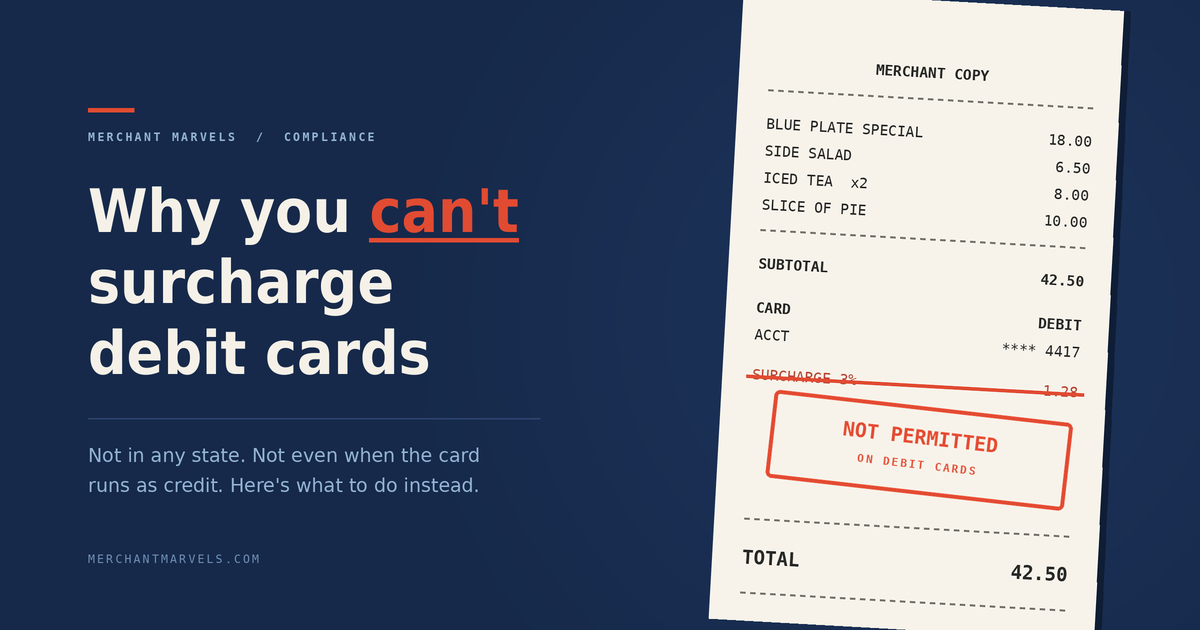
No. You cannot surcharge debit cards — in any state, on any network, under any label.
Surcharging is credit-only. It doesn’t matter whether the customer taps, dips, enters a PIN, or selects “credit” on the terminal screen. It doesn’t matter whether you call the fee a surcharge, a non-cash adjustment, a service fee, or a card fee. If the customer pays a debit card and ends up above your posted price, you are out of compliance.
The good news: there is a compliant way to cover the cost of debit. It just isn’t surcharging. More on that below.
First, what a surcharge actually is
A surcharge is a fee added on top of your posted price because the customer chose to pay by card.
Posted price means shelf price, menu price, website price, quoted price — whatever number the customer saw before they got to the register. Add anything to that number at checkout and you have a surcharge, regardless of the wording on the receipt.
This matters because the entire rulebook keys off that definition. Surcharging is a heavily regulated activity with registration requirements, caps, disclosure obligations, and a list of card types it may never touch. Debit is at the top of that list.
(If you’re still deciding between programs, start with our [cash discount vs. surcharge comparison] — this post assumes you’re already looking at a surcharge program.)
Why debit is off-limits — and where the rule actually comes from
Here’s the compliance nuance almost every article on this topic gets wrong, and it’s worth understanding because it tells you who enforces the rule and what happens to you when it’s broken.
You’ll frequently read that debit surcharging is “banned by the Durbin Amendment.” That’s a shorthand, and it’s not quite right.
The Durbin Amendment (Section 1075 of Dodd-Frank, codified at 15 U.S.C. § 1693o-2, implemented by the Federal Reserve’s Regulation II at 12 CFR Part 235) governs debit interchange and routing — what banks may charge you to accept debit, and which networks a debit transaction may be routed over. It does not contain a line that says “merchants shall not surcharge debit.”
The prohibition that actually binds you comes from a different place: the operating rules of Visa, Mastercard, Discover, and American Express — the rules you contractually agreed to when you signed your merchant agreement. All four prohibit surcharging debit and prepaid cards, nationwide, without exception. Several states then layer statutory debit-specific bans on top (Texas and Maine already do; Louisiana’s took effect August 1, 2026).
Why does this distinction matter to you as a merchant?
Because it means enforcement doesn’t arrive as a letter from a federal agency. It arrives through your acquirer. The networks fine the acquiring bank, the acquiring bank passes it to you, and your merchant account is the leverage. There’s no notice-and-cure process with a regulator, no appeal to the Fed. The fastest possible consequence is that you lose the ability to accept cards at all.
The practical upshot is identical — you can’t do it. But the enforcement path explains why this rule bites so much harder than most merchants expect.
The three traps that catch honest merchants
Nobody sets out to surcharge debit. Almost every violation we see comes from one of these three.
Trap 1: “Run as credit” is still debit
This is the big one.
When a customer inserts a debit card and selects credit instead of entering a PIN, the transaction routes over the Visa or Mastercard credit rails. Many merchants — and a distressing number of POS installers — take that as permission to surcharge it.
It isn’t. That’s a signature debit transaction. The routing changed; the card didn’t. It’s still a debit card drawing on the cardholder’s own bank funds, and network rules classify it by funding source, not by rails. Surcharging signature debit is a violation, full stop.
This is the single most common real-world debit surcharging violation in the country.
Trap 2: Prepaid and gift cards
Prepaid cards — general-purpose reloadable cards, payroll cards, gift cards, government benefit cards — are also excluded from surcharging. Same rule, same reasoning, and they’re easy to miss because they often carry a Visa or Mastercard logo and behave like credit at the terminal.
Trap 3: Your terminal isn’t actually detecting card type
A compliant surcharge program requires BIN-level card detection: the system reads the card’s Bank Identification Number, determines whether it’s credit, debit, or prepaid, and suppresses the surcharge automatically on anything that isn’t consumer or commercial credit.
Two failure modes here:
- Flat-rate configurations. Some processors set a fixed percentage on every card transaction and don’t tell the merchant that debit needs to be carved out. The merchant thinks they bought a compliant program. They didn’t.
- Stale or incomplete BIN tables. New BIN ranges get issued constantly. A system that isn’t updating its tables will start misclassifying cards, and the surcharges keep applying quietly until someone complains.
If your POS can’t show you, on demand, which transactions were surcharged and which were suppressed as debit, you don’t have a compliance program. You have a hope.
What a violation actually costs
Card network penalties for surcharge non-compliance escalate, and they escalate fast.
Visa’s structure typically starts with a modest first-instance assessment and a demand for a remediation plan, then compounds if the violation persists — climbing into six figures over a matter of months, with continuing monthly increases after that. Reported ranges for serious or sustained non-compliance run from roughly $50,000 to $1 million. Visa has publicly increased enforcement of surcharge rules in recent years, so this is not a theoretical risk.
Beyond the fines:
- Merchant account termination. Networks can disqualify a merchant from accepting their cards entirely.
- Chargebacks. A cardholder who was improperly surcharged has grounds to dispute the transaction amount.
- State consumer protection exposure. In ban states, surcharge violations are treated as unfair trade practices, with civil penalties per violation and attorney general enforcement.
- Class action risk. Surcharge practices have been litigated as consumer class actions.
And remember who’s on the hook. Under most merchant agreements, the personal guarantor is.
What to do instead
You have real options. Here are the three that work.
Option 1: Surcharge credit only, and absorb debit
This is the standard compliant surcharge program, and it’s what we set up for established businesses.
How it works: Your posted prices stay exactly as they are. When a customer pays with a consumer or commercial credit card, the terminal adds the surcharge and prints it as a separate line item. When a customer pays with debit or prepaid, the system detects it at the BIN level and suppresses the fee automatically. The customer pays your listed price.
The debit cost is then billed to you at a low fixed rate rather than passed to the customer. In our programs, that’s typically 1.5% on debit — a real cost, but a modest and predictable one.
What compliance requires:
- 30 days’ advance notice to Visa, Mastercard, and your acquirer before your first surcharged transaction
- A surcharge no greater than your actual cost of acceptance, and never above 3% (Visa’s cap since April 2023 — Mastercard permits 4%, but if you accept both, 3% is your ceiling)
- Consistent treatment across networks — you can’t surcharge Visa and exempt Mastercard
- Disclosure at the point of entry, at the point of sale, and on your website checkout
- The surcharge itemized as its own line on every receipt
- Confirmation that surcharging is legal where you operate (see our [state-by-state surcharging guide])
Option 2: Cash discount / dual pricing — the one that reaches debit
Here’s the structural reason this option exists: surcharge rules restrict what you can add to a posted price. Discount rules don’t. Offering a lower price for cash has always been permitted — it was explicitly protected in the Durbin Amendment and it’s permitted under network rules.
So if you want your pricing to cover the cost of all card acceptance — credit, debit, and prepaid alike — you use pricing, not fees.
How it works: You set your listed prices to reflect the card price. A customer paying cash receives a discount off that listed price. Everyone paying by card — any card — pays the listed price and is never charged above it. No surcharge is ever applied, so the debit prohibition simply doesn’t come into play.
Why merchants prefer it:
- It legally covers debit volume, which surcharging cannot
- It works in states where surcharging is banned or restricted
- No network registration, no 3% cap, no BIN-detection dependency
- Customers see one price and a discount, which tends to land better than a fee at checkout
The critical caveat — and this is where a lot of programs go wrong. A cash discount must be a genuine discount off the posted price. If your system adds a percentage at checkout and then removes it for cash customers, that is a surcharge with different labeling. Visa addressed this directly in a 2018 acquirer bulletin: adding a fee to the normal price and waiving it at the register is not a discount program, and merchants running it are subject to non-compliance action.
Watch for these red flags in any “cash discount” program you’re sold:
- A “non-cash adjustment,” “service fee,” or “card fee” line appearing at checkout
- The cash price displayed on menus and shelves, with the card price only revealed at payment
- A fee that lands on debit cards under any name
If your customer’s total goes up from what was posted, it’s a surcharge. The label on the receipt is irrelevant.
Option 3: Convenience and service fees (narrow, but real)
Certain merchant categories — government, education, utilities, some professional services — may charge a flat convenience fee on an alternative payment channel, or a service fee under specific network programs. These have their own tight qualification rules and generally can’t be combined with surcharging. Worth asking about if you’re in one of those verticals; not a general-purpose solution.
Run your own numbers before you choose
This is the part most merchants skip, and it’s the difference between a program that works and one that disappoints.
Pull three months of statements and find your debit-to-credit split. Debit is roughly half of US card volume by transaction count, but the mix varies enormously by business type. A quick-service restaurant with a $12 average ticket looks nothing like a jeweler with a $900 average ticket.
Then do the math:
- Heavy credit mix (higher tickets, B2B, professional services, specialty retail): a compliant credit-only surcharge program covers most of your cost. Your absorbed debit expense is small.
- Heavy debit mix (convenience, grocery, QSR, low average ticket): surcharging leaves a substantial share of your volume uncovered, and you’ll be paying that out of margin every month. Cash discount or dual pricing is usually the better fit.
“Zero-fee processing” is a marketing phrase. Under a credit-only surcharge program, your debit volume is a genuine line-item cost. Anyone who tells you otherwise either doesn’t understand the rules or is hoping you don’t.
Compliance checklist
Before you turn any program on:
- Confirm surcharging is legal in every state where you take payments — including card-not-present sales
- Provide 30 days’ notice to Visa, Mastercard, and your acquirer
- Calculate your true effective rate; set the surcharge at or below it, and never above 3%
- Verify BIN-level detection actively suppresses debit and prepaid — test it with a real debit card
- Post disclosure at the entrance, at the register, and on your website checkout page
- Confirm the surcharge prints as a separate line item on every receipt
- Apply the surcharge consistently across all card networks
- Audit your first 90 days of transactions for any surcharge that landed on a debit card
- If you’re on a cash discount program: confirm your posted prices are the card prices, and that nothing is added at checkout
FAQ
Can you surcharge debit cards if the customer chooses “credit” at the terminal? No. That’s a signature debit transaction. It’s classified by funding source, not by which rails it routes over. Surcharging it is a violation.
Can you surcharge debit cards in states where credit surcharging is legal? No. The debit prohibition is nationwide and comes from network rules, so state permissiveness on credit surcharging doesn’t change it.
What if I call it a non-cash adjustment or a service fee? The name doesn’t matter. Anything that takes the customer above your posted price is a surcharge, and surcharges can’t touch debit.
Can I charge a flat dollar fee instead of a percentage on debit? Not as a surcharge. A flat fee added to the posted price on a debit transaction is the same violation.
Does this apply to online and phone orders? Yes. Card-not-present transactions follow the same rules, with disclosure required before the customer completes payment.
Is a cash discount program legal everywhere? Genuine discounts for cash are broadly permitted, including in states that ban surcharging — provided the program is structured as a real discount off the listed price and not a surcharge with a different name.
Set it up right the first time
The rules around surcharging aren’t complicated once someone lays them out. What gets merchants in trouble is a program configured by someone who never checked whether debit was being excluded — and by the time a fine shows up, months of transactions are already on the books.
At Merchant Marvels, we build every program around the merchant’s actual debit mix and actual state rules. We file the network notifications, configure BIN-level detection and test it, supply compliant signage and receipt formatting, and set your rate against your real cost of acceptance — not an arbitrary number. If a cash discount or dual pricing structure fits your business better than surcharging, we’ll tell you that instead.
We set your program up so you stay fully compliant — ask us how.
This article is general information for merchants, not legal advice. Card network rules and state statutes change; verify current requirements for your jurisdiction before implementing any program.